Secure Overlay Networks for Private, Resilient Enterprise Connectivity
Protect Enterprise Traffic Across Untrusted WAN Networks
Enterprise WAN traffic increasingly crosses infrastructure that the organization does not own or directly control. Internet circuits, carrier networks, broadband services, wireless connections and cloud connectivity may all form part of the path between users, applications, branches and data centers. While these services provide reachability, they should not automatically be treated as trusted transport for sensitive business traffic.
Even private WAN services such as MPLS are primarily designed to provide traffic separation and predictable connectivity, rather than cryptographic confidentiality. A secure network architecture therefore needs to protect data independently of the characteristics of the underlying carrier service.
A secure overlay addresses this by creating an encrypted logical network across the available WAN infrastructure. Traffic is protected between trusted endpoints, allowing organizations to use public and private transport services while maintaining consistent confidentiality and isolation across the enterprise network.
What Is a Secure Overlay Network?
A secure overlay network is a logical network created across one or more underlying WAN transport services. Instead of relying on the carrier network itself to provide confidentiality and isolation, the overlay protects traffic between trusted endpoints using encryption and applies the required network logic independently of the physical transport.
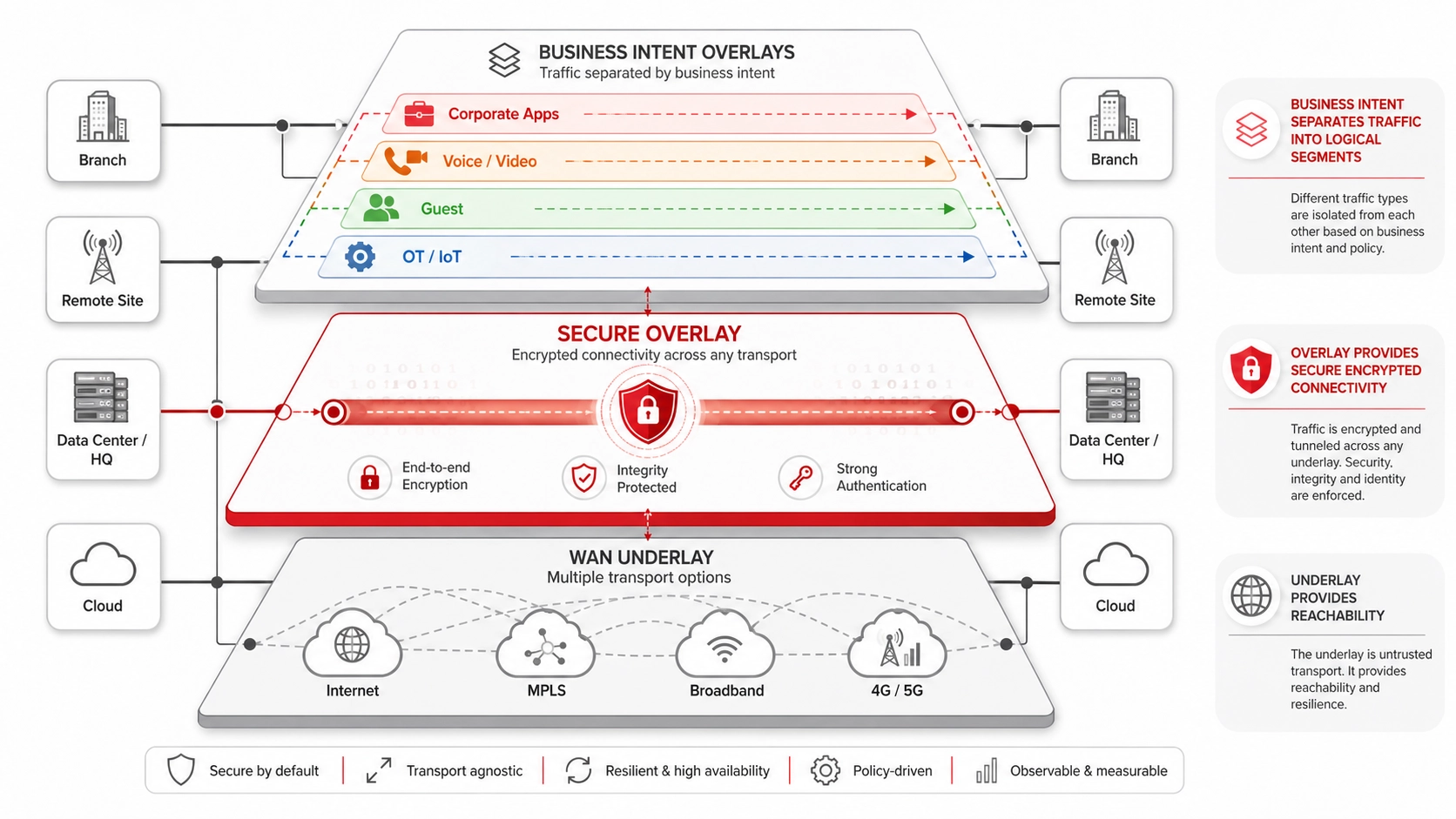
The underlying network, or underlay, is responsible for basic connectivity between locations. This may consist of Internet, MPLS, broadband, wireless, satellite or cloud connectivity. The secure overlay operates above these services, creating a consistent trusted network regardless of which transport is carrying the traffic.
This separation of overlay and underlay allows organizations to change carriers, combine multiple connection types and extend connectivity to new locations without fundamentally redesigning the security architecture. The enterprise network is defined by the overlay rather than by the characteristics or trust level of the underlying WAN.
How a Secure Overlay Network Works
Secure overlay networks establish protected connectivity between trusted network endpoints, such as branch appliances, data center gateways, cloud gateways or other authorized edge devices. When traffic enters the overlay, it is encrypted before being transmitted across the underlying WAN and decrypted only when it reaches an authorized destination.
The physical path taken by the traffic may change depending on which transport is available. A packet could cross an Internet circuit, MPLS service, broadband connection, wireless network or another carrier service, while remaining protected by the same overlay security architecture.
Because the overlay is logically separated from the transport beneath it, the enterprise can maintain consistent encrypted connectivity even when multiple carriers or connection types are used. The underlay provides reachability between endpoints; the secure overlay provides the trusted network used to carry enterprise traffic.
Transport Independence
A secure overlay network is not tied to a specific carrier service or connection type. The same encrypted logical network can operate across Internet, MPLS, broadband, leased lines, 4G/5G, satellite and cloud connectivity, allowing organizations to use the transport services that best meet their cost, availability and performance requirements.
This separation between overlay and underlay reduces dependence on the characteristics of any individual WAN service. New circuits can be introduced, carriers can be changed and additional transport paths can be added without fundamentally redesigning the security model. The overlay continues to provide the trusted network while the underlay provides reachability.
When delivered through SD-WAN, the overlay can also distribute traffic across multiple underlay connections simultaneously. Individual packets may traverse different transport paths before being reassembled at the receiving SD-WAN endpoint. This improves resilience and application performance, while also making interception or interference on any single underlay path less useful because that path may contain only part of the overall traffic stream.
A branch, for example, might use MPLS, Internet and 5G concurrently as components of the same secure overlay. The SD-WAN fabric can dynamically use these paths according to application requirements, network conditions and business intent, allowing the enterprise to combine transport diversity, encryption and multi-path forwarding within a single secure network architecture.
Segmentation Through Business Intent Overlays
A secure overlay network can divide enterprise traffic into multiple logically isolated segments while allowing those segments to share the same physical WAN infrastructure. This creates clear security boundaries between different classes of traffic without requiring a separate physical network for each one.
Business-critical applications, voice and video, guest access, OT/IoT systems and other traffic categories can each operate within their own overlay. Traffic in one segment is kept separate from traffic in another, reducing the opportunity for unauthorized access or lateral movement between systems with different security requirements.
Segmentation also allows more sensitive traffic to be subject to stricter controls than less trusted or lower-risk traffic. For example, OT systems can remain isolated from general corporate users, guest traffic can be prevented from reaching internal resources, and critical applications can be confined to explicitly authorized destinations.
Because these security boundaries exist within the overlay itself, they can remain consistent across branches, data centers, cloud environments and different WAN transports. The result is a more compartmentalized network in which a compromise or exposure affecting one traffic segment is less likely to provide access to the rest of the enterprise.
Secure Overlay Networks vs Traditional IPsec VPN Architectures
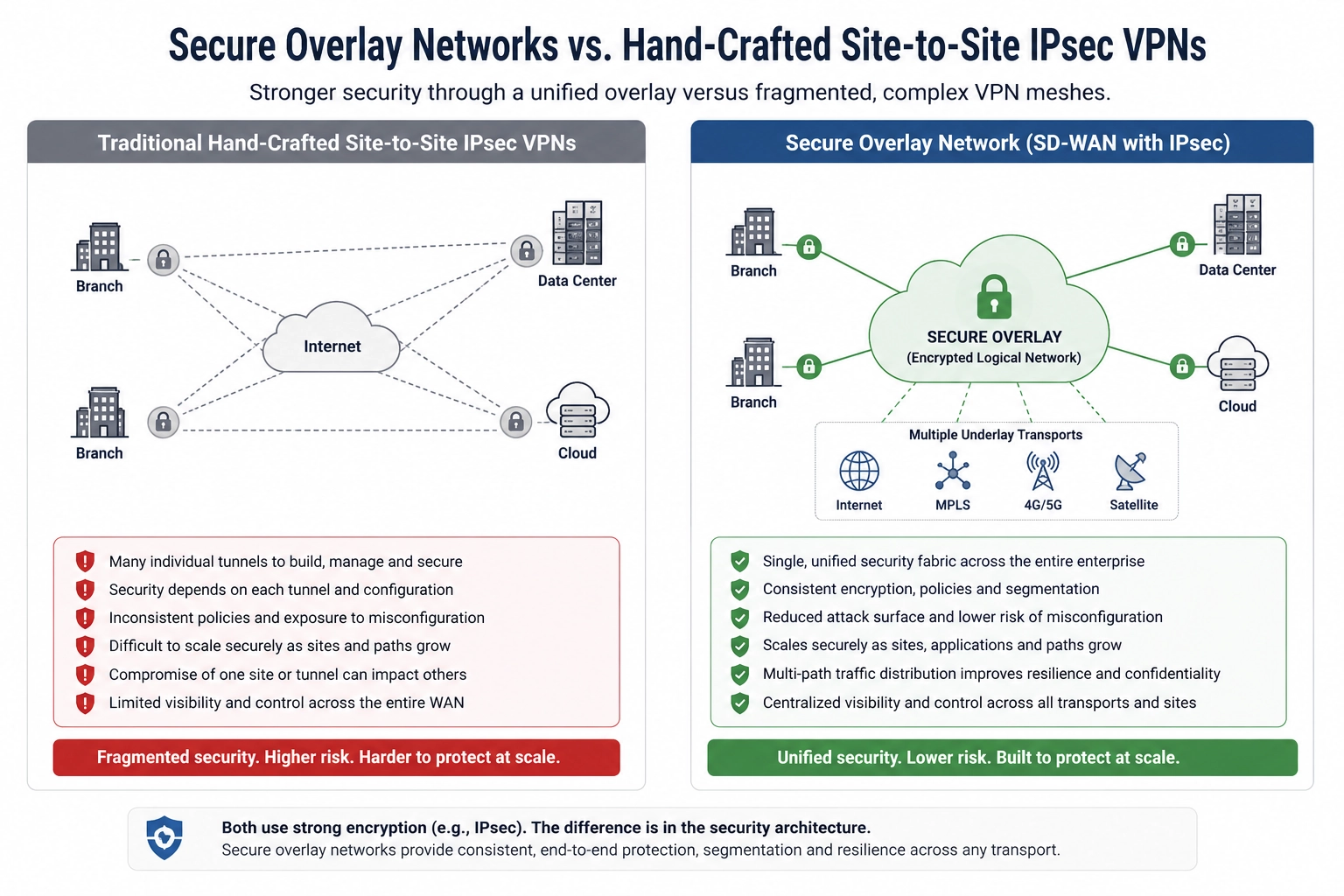
Traditional IPsec VPNs can provide strong encryption between individual locations, but they are typically built as a collection of discrete tunnels. As the number of sites, applications and connection paths increases, the security architecture can become increasingly fragmented, with protection depending on how individual tunnels, routes and policies have been configured.
A secure overlay network provides a more consistent security model across the enterprise. Encryption, segmentation and trusted connectivity are applied as part of the overlay itself rather than being treated as separate point-to-point constructs. This makes it easier to maintain the same security principles across branches, data centers, cloud environments and multiple WAN transports.
The overlay model also reduces reliance on a single predefined path between endpoints. Traffic can move securely across different underlay connections while remaining within the same trusted logical network. This helps preserve confidentiality and continuity even when circuits fail, routes change or traffic is distributed across multiple transport paths.
The key distinction is therefore not the strength of IPsec encryption itself, but the architecture surrounding it. A secure overlay uses encryption as one component of a broader security fabric that combines protected transport, segmentation, path diversity and consistent security boundaries across the WAN.
Secure Overlay Networking and SD-WAN
Modern SD-WAN platforms provide the control and automation needed to operate a secure overlay consistently across a distributed enterprise. Rather than building and maintaining large numbers of individual site-to-site VPNs, the secure overlay is established as a unified network fabric across branches, data centers, cloud environments and multiple WAN transports.
This allows encryption and segmentation to be applied consistently as the network grows. New locations can join the secure fabric without requiring a complete redesign of the underlying security architecture, and traffic can remain protected even as it moves across different carriers, circuits or paths.
SD-WAN also strengthens the overlay by combining secure connectivity with path diversity. Traffic can be distributed across multiple underlay connections, redirected when a path degrades or fails, and kept within the same protected logical network throughout. The result is a security architecture that is both more resilient and less dependent on any single transport service.
In this model, SD-WAN is not simply a mechanism for selecting the best WAN path. It becomes the foundation for creating and maintaining a secure, encrypted and segmented enterprise network across infrastructure that may otherwise be untrusted.
Security Without Sacrificing Application Performance
Strong encryption and segmentation should not require organizations to accept poor application performance. A secure overlay can protect traffic while also using multiple WAN paths intelligently to maintain application availability and responsiveness.
Because traffic is carried within the overlay rather than being tied to a single physical circuit, the network can continue to use alternative paths when a connection becomes congested, degraded or unavailable. This helps preserve secure connectivity without forcing applications to depend on the performance characteristics of any one underlay service.
Advanced SD-WAN capabilities can further improve application performance through techniques such as dynamic path selection, multi-path packet steering, Forward Error Correction (FEC) and Packet Order Correction (POC). These functions operate alongside the secure overlay, helping to reduce the impact of packet loss, latency, congestion and path failure while traffic remains encrypted in transit.
The result is an architecture in which security, resilience and application performance reinforce each other. Enterprise traffic remains protected across untrusted WAN infrastructure while the network continuously adapts to changing transport conditions.
Common Secure Overlay Network Use Cases
Secure overlay networks are useful wherever sensitive enterprise traffic must cross infrastructure that cannot be treated as inherently trusted. They are particularly valuable in distributed environments where organizations need consistent protection across multiple sites, carriers and connection types.
Secure Branch Connectivity
Protect traffic between branch locations, data centers and cloud environments using encrypted connectivity that does not depend on the security of the underlying carrier network.
MPLS Augmentation or Replacement
Extend secure enterprise connectivity across Internet and other lower-cost transports while maintaining encryption and segmentation independently of the WAN service.
International WAN Connectivity
Protect business-critical traffic as it crosses multiple carriers, jurisdictions and network infrastructures outside the direct control of the organization.
Cloud Connectivity
Extend the secure overlay into cloud environments so that traffic between users, sites, workloads and data centers remains protected across hybrid and multi-cloud architectures.
OT and IoT Segmentation
Isolate operational technology and IoT traffic from general enterprise traffic, helping reduce lateral movement and limit the potential impact of a compromised device or system.
Mergers, Acquisitions and New Sites
Bring newly acquired businesses or locations into a protected enterprise network without requiring immediate standardization of the underlying carrier infrastructure.
Why Hararei
Hararei approaches secure overlay networking as an enterprise architecture problem rather than simply a connectivity purchase. The design needs to account for the sensitivity of the traffic being carried, the trust level of the underlying transports, segmentation requirements, application dependencies, resilience objectives and the operational model used to support the environment.
We help organizations determine how secure overlays should be structured across branches, data centers, cloud environments and multiple WAN services, with particular attention to encryption, isolation, path diversity and failure scenarios. The objective is to create a network that remains secure even when the infrastructure beneath it changes or cannot be fully trusted.
Where appropriate, Hararei can also integrate secure overlay networking with broader SD-WAN, cloud connectivity and network security initiatives, allowing the overlay to form part of a more complete enterprise networking strategy rather than operating as an isolated point solution.
Hararei are channel partners for Aruba , with their Aruba EdgeConnect® products, and have extensive experience with secure networking.
Contact Us Please contact Hararei for an in-depth discussion on using any of our Cloud or Cybersecurity products or services