Packet-by-Packet Traffic Steering
How intelligent packet-level path selection improves WAN resilience, bandwidth utilization and application performance across multiple links.
Introduction to Packet Steering
Traditional WAN redundancy is often built around entire links or traffic flows. A primary circuit may carry traffic until it fails, or individual sessions may be assigned to one of several available paths. These approaches provide resilience and can improve aggregate bandwidth utilization, but they still treat each flow as a single unit that normally remains tied to one path.
Packet-by-packet traffic steering takes a more granular approach. Instead of assigning an entire session to a single WAN link, individual packets within the same flow can be distributed across multiple eligible paths. This allows the network to use available capacity more effectively and react more quickly to changing link conditions.
The approach introduces additional engineering challenges. Paths may have different latency, jitter, loss and available bandwidth, causing packets to arrive out of order or exposing some traffic to impaired links. Effective packet-level steering therefore depends on complementary mechanisms such as Packet Order Correction, Forward Error Correction and continuous measurement of path quality.
Traditional WAN Failover
The simplest form of WAN redundancy uses a primary and secondary connection. Under normal conditions, traffic is sent across the preferred link while the backup remains idle or carries only limited traffic. If the primary link fails, the network detects the failure and redirects traffic to the alternate path.
This approach is straightforward and predictable, but it makes inefficient use of available bandwidth. Capacity on the standby link is largely unused during normal operation, even though it may represent a significant proportion of the total WAN investment.
Failure Detection and Convergence
Traditional failover also depends on detecting that the primary path is no longer usable. Depending on the technology involved, this may rely on interface state, routing protocol timers, health probes, or other monitoring mechanisms. Traffic can be interrupted while the failure is detected and forwarding converges onto the backup path.
The Brownout Problem
A more difficult condition occurs when a WAN link remains technically available but its performance deteriorates. High packet loss, latency, or jitter may severely affect applications without causing the circuit itself to be declared down. This is often referred to as a brownout.
In a simple active/standby design, traffic may continue to use the degraded primary link because the redundancy mechanism is primarily looking for complete failure rather than application-level performance. The backup circuit remains available, but its capacity is not used to relieve the impaired path.
Resilience Without Bandwidth Aggregation
Active/standby failover therefore provides link resilience, but it does not normally aggregate the capacity of the available WAN connections. Two 100 Mbps circuits may provide redundancy, but the usable capacity during normal operation remains close to that of a single 100 Mbps link.
More advanced traffic-steering techniques improve on this model by allowing multiple links to participate simultaneously, first at the flow level and ultimately at the individual packet level.
Flow-Based Load Balancing
Flow-based load balancing improves on active/standby failover by allowing multiple WAN links to carry traffic at the same time. Instead of reserving one connection primarily for backup, new traffic flows can be distributed across the available paths according to policy, link utilization, or other selection criteria.
Once a flow has been assigned to a particular path, however, it normally remains on that path for the duration of the session. This preserves packet ordering and keeps the forwarding logic relatively simple, but it also means that the performance of an individual flow is constrained by the characteristics of the selected link.
Improved Aggregate Utilization
Because different flows can use different WAN connections, flow-based balancing can make much better use of total available bandwidth than an active/standby design. For example, separate application sessions may be distributed across two 100 Mbps links, allowing the network as a whole to approach the combined capacity of both circuits.
This does not mean that a single session can normally use the full aggregate capacity. A large file transfer assigned to one 100 Mbps link remains limited by that link even if substantial unused bandwidth is available on the second connection.
Uneven Link Utilization
Flow sizes are rarely equal. One flow may consist of a small web transaction while another may carry a large data transfer for several minutes. As a result, distributing the same number of flows across two links does not necessarily produce an even distribution of bandwidth.
A WAN may therefore reach a condition where one link is heavily utilized while another still has significant spare capacity. Existing long-lived flows cannot always be moved without disrupting the session, so the imbalance may persist until those flows end.
Flow Affinity Limits Responsiveness
Binding a flow to a particular path also limits how quickly the network can respond to changes in link performance. If latency, loss, or congestion deteriorates after a flow has been established, the system may need to move the entire flow to another path or wait for a new session before making a different forwarding decision.
Packet-by-packet traffic steering removes this flow-level constraint. By making forwarding decisions at a finer granularity, it can distribute traffic across multiple eligible links within the same session and respond more rapidly to changes in available capacity and path quality.
Packet-by-Packet Traffic Steering
Packet-by-packet traffic steering makes forwarding decisions at a finer level than flow-based load balancing. Instead of assigning an entire session to one WAN path, the network can distribute individual packets from the same flow across multiple eligible links.
This allows the available WAN capacity to be used more efficiently, particularly when individual flows are large or long-lived. A single session is no longer necessarily constrained by the bandwidth of one physical connection and can potentially benefit from capacity available across several paths.
More Granular Use of Available Capacity
Because packets can be distributed independently, the steering mechanism can react to link utilization much more quickly than a system that waits for flows to begin or end. If one path becomes more heavily utilized, subsequent packets can be directed toward another eligible path without requiring the application session itself to be re-established.
This granularity can reduce the uneven utilization that occurs with flow-based balancing, where a small number of large sessions may dominate one link while capacity remains available elsewhere.
Continuous Path Selection
Packet-level steering can also incorporate continuously measured path characteristics such as latency, packet loss, jitter, and available bandwidth. Paths that continue to meet the required performance criteria can participate in forwarding, while degraded paths can be used less aggressively or removed from eligibility.
The forwarding decision therefore becomes an ongoing process rather than a decision made only when a new flow is established. This gives the network greater flexibility to adapt as WAN conditions change.
The Trade-Off
The main challenge is that packets sent across different paths may not arrive in the same order in which they were transmitted. Differences in propagation delay, queuing, and jitter can cause packets using a faster path to overtake packets sent earlier on a slower path.
For this reason, effective packet-by-packet steering is normally combined with mechanisms such as Packet Order Correction and Forward Error Correction. These capabilities allow the network to gain the utilization and resiliency benefits of packet-level distribution while minimizing the effects of path variation on the application.
Using the Aggregate Capacity of Multiple Links
One of the principal advantages of packet-by-packet traffic steering is that it can make the combined capacity of multiple WAN links available to the same traffic flow. This differs fundamentally from active/standby and flow-based approaches, where an individual session is normally limited to the capacity of a single path.
Consider two WAN connections, each providing 100 Mbps of usable bandwidth. In an active/standby design, normal traffic is typically limited to approximately 100 Mbps because the secondary link is reserved for failover. Flow-based load balancing can use both links simultaneously, but a single large session will still normally remain confined to one 100 Mbps path.
WAN 1: 100 Mbps
WAN 2: 100 Mbps

Active/Standby:
Single-flow capacity ≈ 100 Mbps

Flow-Based Load Balancing:
Aggregate capacity ≈ 200 Mbps
Single-flow capacity ≤ 100 Mbps

Packet-by-Packet Steering:
Aggregate capacity ≈ 200 Mbps
A single flow can potentially use capacity across both paths
Reducing Stranded Bandwidth
Flow-based balancing can leave usable bandwidth stranded on one connection while another is heavily utilized. This commonly occurs when a small number of long-lived or high-volume sessions happen to be assigned to the same path.
Packet-level distribution reduces this dependency on flow size and duration. Traffic can be spread across the available links as capacity becomes available, allowing the system to maintain a more even utilization profile.
Capacity Is Not Always Additive
The theoretical combined bandwidth of multiple links does not automatically translate into equivalent application throughput. Protocol overhead, packet loss, latency, jitter, differing path speeds, congestion, and packet-recovery mechanisms can all reduce the effective capacity available to an application.
The objective is therefore not simply to add the nominal bandwidth values of the underlying circuits, but to make the usable capacity of all qualifying paths available to traffic as efficiently as possible.
Greater Value from Diverse WAN Connections
This approach can also improve the economic value of WAN redundancy. Instead of maintaining secondary connectivity primarily for emergency use, packet-by-packet steering allows multiple circuits to contribute useful capacity during normal operation while still remaining available to provide resilience if another path becomes unavailable.
Responding to Link Degradation and Brownouts
A WAN link does not need to fail completely to become unsuitable for application traffic. Congestion, carrier problems, wireless interference, or changing Internet conditions can increase packet loss, latency, or jitter while the connection itself remains operational. These partial failures, commonly referred to as brownouts, can be more difficult to manage than a complete link failure.
Beyond Up or Down
Traditional redundancy mechanisms frequently make forwarding decisions based primarily on whether a path is reachable. Packet-by-packet steering can instead use continuous measurements of path quality to determine whether a link remains suitable for carrying traffic.
Metrics such as packet loss, latency and jitter provide a more complete indication of the actual condition of the path. A link can therefore remain physically available while being considered unsuitable for applications whose performance requirements it can no longer meet.
Responding Without Waiting for a Flow to End
With flow-based steering, a session already assigned to a degrading path may continue to experience poor performance until the system moves the entire flow or the session ends. Packet-level steering provides a finer degree of control because subsequent packets can be directed toward other qualifying paths without waiting for a new session to be established.
This allows the network to react to changing conditions on a much shorter timescale and reduces the amount of application traffic exposed to an impaired path.
Removing and Restoring Paths
If the quality of a path deteriorates beyond defined performance thresholds, it can be removed from the set of links eligible to carry particular traffic. Packets can then be distributed across the remaining qualifying paths while the degraded link continues to be monitored.
When its performance returns to an acceptable level, the path can again become eligible and contribute capacity. This allows the WAN to respond not only to complete failures, but also to temporary and intermittent degradation.
Application Performance Rather Than Link Availability
The important distinction is that redundancy becomes based on the ability of a path to deliver an acceptable service rather than simply its ability to pass traffic. Packet-by-packet steering can therefore treat a severely degraded link as effectively unavailable for sensitive traffic even though the underlying circuit remains up.
The Challenge of Different Path Characteristics
Using multiple WAN links simultaneously introduces an important engineering challenge: the available paths are rarely identical. Internet connections from different service providers, private circuits, broadband, wireless, and satellite links can have very different latency, jitter, loss, and bandwidth characteristics.
When packets from the same flow are distributed across these paths, they experience different transit times. A packet sent later over a faster path may therefore arrive before a packet that was sent earlier over a slower path.
Path Delay Differential
The difference in latency between two paths is known as the path delay differential. Consider two links with one-way delays of 20 ms and 60 ms. If consecutive packets are distributed between them, packets travelling over the faster path can arrive tens of milliseconds ahead of packets that were transmitted earlier over the slower path.
Packet 1 → Path A → 60 ms
Packet 2 → Path B → 20 ms
Packet 3 → Path A → 60 ms
Packet 4 → Path B → 20 ms

Possible arrival order:

Packet 2 → Packet 4 → Packet 1 → Packet 3
The packets have not necessarily been lost, but the receiving system must compensate for the difference in path delay before presenting the traffic to protocols that expect ordered delivery.
Path Characteristics Are Dynamic
The challenge is greater because WAN performance changes continuously. Queuing and congestion can alter latency from moment to moment, while packet loss and jitter may appear intermittently. The path that provides the lowest latency at one point may not remain the best-performing path throughout the lifetime of a session.
Packet-by-packet steering must therefore operate with an understanding of current path conditions rather than assuming that the characteristics of each WAN connection are fixed.
Packet-Level Steering Requires Packet-Level Correction
The ability to distribute packets across dissimilar links provides significant advantages in bandwidth utilization and resilience, but those benefits depend on managing the impairments introduced by multipath delivery. Out-of-order packets must be resequenced, while packets genuinely lost in transit may require recovery.
This is why Packet Order Correction and Forward Error Correction are important complementary technologies. Packet Order Correction compensates for differences in packet arrival time, while FEC can reconstruct recoverable packet loss without waiting for end-to-end retransmission.
Interaction with Packet Order Correction (POC) and Forward Error Correction (FEC)
Packet-by-packet traffic steering gains much of its flexibility by allowing packets from the same flow to traverse different WAN paths. Because those paths may have different latency, jitter, and loss characteristics, the receiving system must be able to distinguish between packets that are merely delayed and packets that have actually been lost.
Packet Order Correction (POC)
When packets travel across paths with different transit times, they may arrive in a different sequence from the one in which they were transmitted. POC temporarily buffers out-of-sequence packets and restores the correct sequence before forwarding the traffic.
This allows packet-level steering to use paths with different delay characteristics without unnecessarily exposing reordering to higher-layer protocols such as TCP.
Forward Error Correction (FEC)
If a packet fails to arrive within the expected reorder window, it may be treated as lost rather than simply delayed. FEC can then be used to reconstruct recoverable packet loss from redundant information transmitted with the original traffic.
This avoids waiting for an end-to-end retransmission, which can be particularly important across higher-latency WAN connections.
Complementary Functions
The two mechanisms therefore address different consequences of packet-level multipathing. POC deals with packets that arrive late or out of sequence, while FEC addresses packets that do not arrive at all.
Used together, POC and FEC allow packet-by-packet traffic steering to make aggressive use of multiple WAN paths while reducing the impact that path delay differences and packet loss would otherwise have on application performance.
Application-Aware Steering and Business Policy
The value of packet-by-packet traffic steering is not simply that it can use multiple WAN links. Its greater advantage is that path selection can be aligned with the performance requirements of individual applications. Different applications react very differently to latency, jitter, packet loss, congestion, and available bandwidth, so treating all traffic identically can produce poor results even when sufficient network capacity exists.
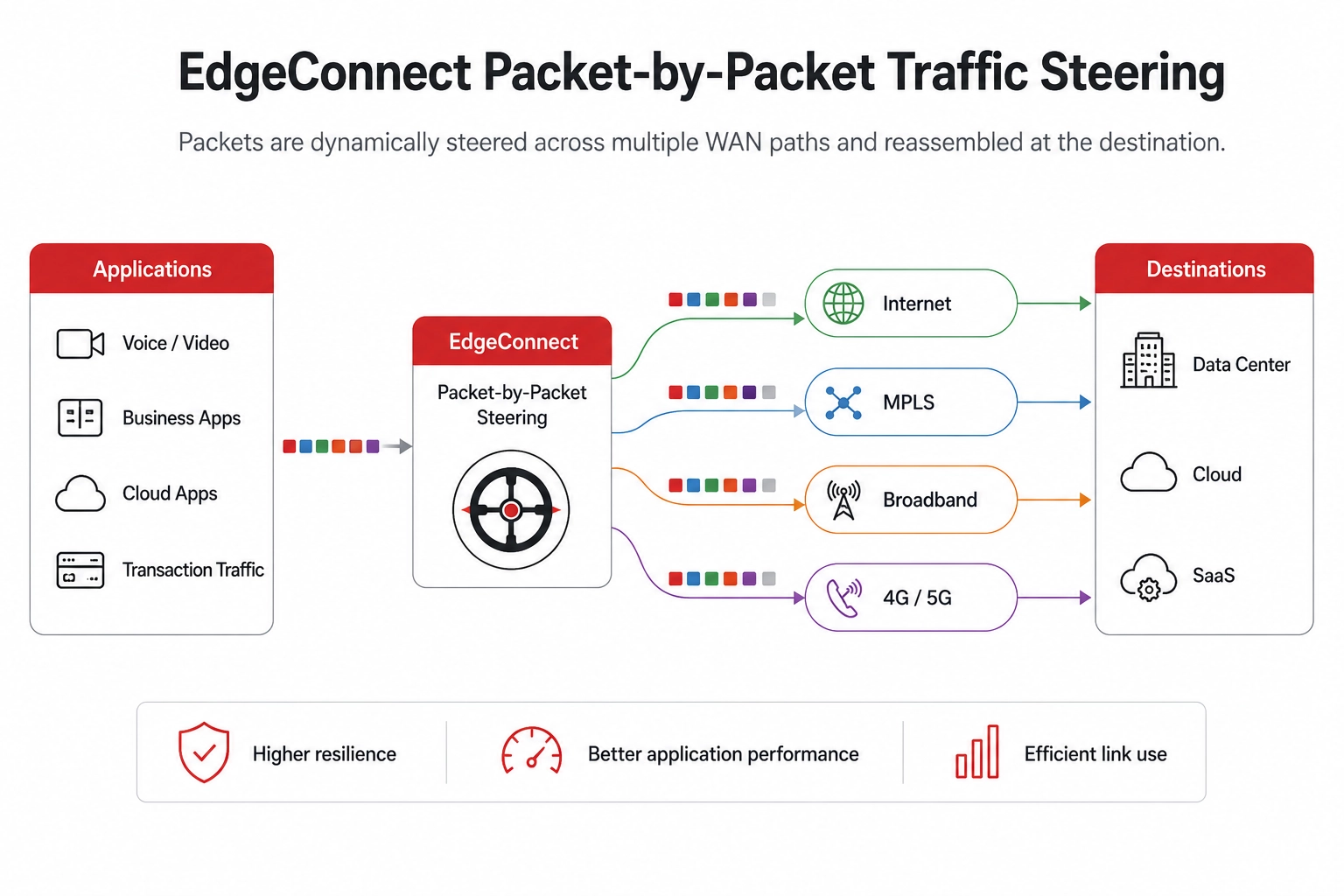
Real-time voice and video require consistently low latency and jitter, interactive business applications depend on responsive round-trip performance, and large data transfers may benefit most from maximum aggregate throughput. Application-aware steering allows the WAN to select and use paths according to these requirements rather than relying on a single generic forwarding strategy.
Application Performance as the Primary Objective
A path can be operational and still provide unacceptable application performance. A circuit experiencing elevated latency, jitter, or packet loss may continue to pass traffic successfully while causing poor voice quality, slow application response, reduced TCP throughput, or interrupted user sessions.
Application-aware steering therefore evaluates more than simple reachability. Paths can be selected according to whether they are currently capable of delivering the level of performance required by a particular application. This allows the WAN to respond to degradation before it becomes a complete circuit failure.
Defining Path Requirements
Business policy can establish acceptable performance characteristics for different classes of traffic. These may include thresholds for latency, jitter, packet loss, available bandwidth, or other measures of path quality. A path that remains perfectly acceptable for backup traffic or a bulk file transfer may therefore be excluded from carrying a latency-sensitive voice or interactive application.
This distinction is important because the best WAN path is not necessarily the path with the lowest utilization or highest nominal bandwidth. The most appropriate path is the one that can currently deliver the performance characteristics required by the application.
Different Applications, Different Steering Strategies
Application requirements can also determine how aggressively multiple paths are used. A high-volume data transfer may benefit from packet-by-packet distribution across all qualifying links so that it can take advantage of available aggregate bandwidth. A latency-sensitive application may instead be restricted to paths that consistently meet tighter performance thresholds.
Similarly, critical applications may be given access to higher-quality or more resilient paths, while lower-priority traffic can make use of remaining capacity. Packet-by-packet steering therefore becomes part of a broader performance policy rather than simply a mechanism for balancing traffic.
Maintaining Performance as Conditions Change
WAN conditions are dynamic. A path that performs well at one moment may become congested or experience increased latency, jitter, or loss later in the same session. Continuous path measurement allows the steering mechanism to respond as those conditions change and direct subsequent packets toward paths that continue to meet the application's requirements.
This ability to react during the lifetime of a session is particularly important for long-running and performance-sensitive applications. It reduces the amount of time that application traffic remains exposed to a deteriorating path and helps maintain more consistent user experience even when the underlying WAN is changing.
Aligning WAN Behaviour with Business Intent
The result is a shift from link-centric routing toward application-performance-driven WAN behaviour. The network is no longer simply deciding whether a circuit is available; it is determining whether that circuit is currently appropriate for the application that needs to use it and whether another path can provide a better outcome.
By combining application awareness, continuous path measurement, packet-level steering, POC, and FEC, the WAN can use multiple links not only for resilience and capacity, but also to actively protect application performance. This allows network resources to be consumed according to business importance and application sensitivity, rather than according to static routing decisions alone.
Summary of Traffic Steering
Packet-by-packet traffic steering represents a significant evolution beyond traditional active/standby redundancy and flow-based load balancing. By making forwarding decisions at the individual packet level, traffic can use the available capacity across multiple WAN paths rather than binding an entire session to a single link.
This finer level of control allows the WAN to respond more rapidly to changing network conditions, make better use of aggregate bandwidth, and reduce the impact of link degradation and brownouts. When paths have different latency, jitter, or loss characteristics, POC and FEC provide complementary mechanisms for correcting packet reordering and recovering packet loss.
Most importantly, packet-level steering allows WAN decisions to be driven by application performance rather than simple link availability. By continuously evaluating path quality and applying application-aware business policy, traffic can be directed across the paths best able to meet its performance requirements, providing more consistent application experience while making more effective use of the available WAN infrastructure.
Contact Us Please contact Hararei for an in-depth discussion on using any of our Cloud or Cybersecurity products or services