Forward Error Correction in SD-WAN
Why packet loss has a disproportionate impact on application performance and why Forward Error Correction is used to mitigate it.
Overview - Forward Error Correction (FEC)
IP networks are designed to tolerate a certain degree of packet loss, but many business applications are highly sensitive to its effects. Voice and video can experience distortion, gaps, or degraded quality, while TCP-based applications may respond to packet loss by retransmitting data and reducing their transmission rate. On WAN connections, particularly Internet, wireless links, and especially satellite links, even relatively low levels of packet loss can have a disproportionate effect on application performance.
Traditional packet recovery relies on retransmission, which requires the loss to be detected and the missing data sent again. The effectiveness of this approach decreases as network latency increases because every retransmission introduces additional delay. For applications operating across long-distance WAN connections, waiting for lost packets to be retransmitted can significantly reduce throughput and impair the user experience.
FEC can work together with other path conditioning technologies such as Packet Order Correction (POC) to provide a cleaner network, which helps applications perform better over the network.
TCP performance across a WAN is constrained not only by the available link capacity, but also by latency and packet loss. A commonly used approximation, known as the Mathis equation, demonstrates how TCP throughput declines as round-trip latency increases and packet loss becomes more frequent. This relationship helps explain why a high-bandwidth WAN circuit can still deliver unexpectedly poor application performance when even modest packet loss is present.
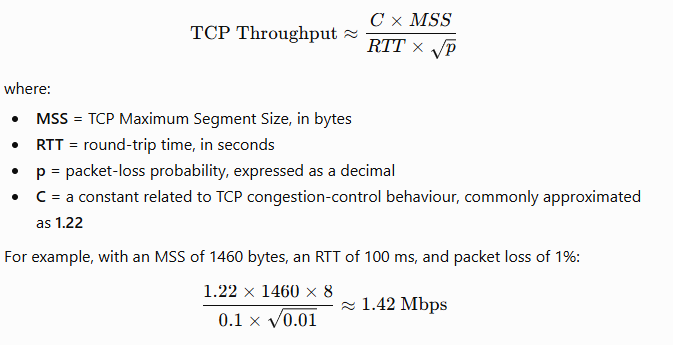
The Mathis Equation approximates the maximum acheivable bandwidth with given network latency and packet loss
By incorporating additional checksum information in the traffic stream, retransmissions can be avoided, which increases effective bandwidth, particularly on lossy links. There is however a cost to incorporating additional checksums into the traffic stream.
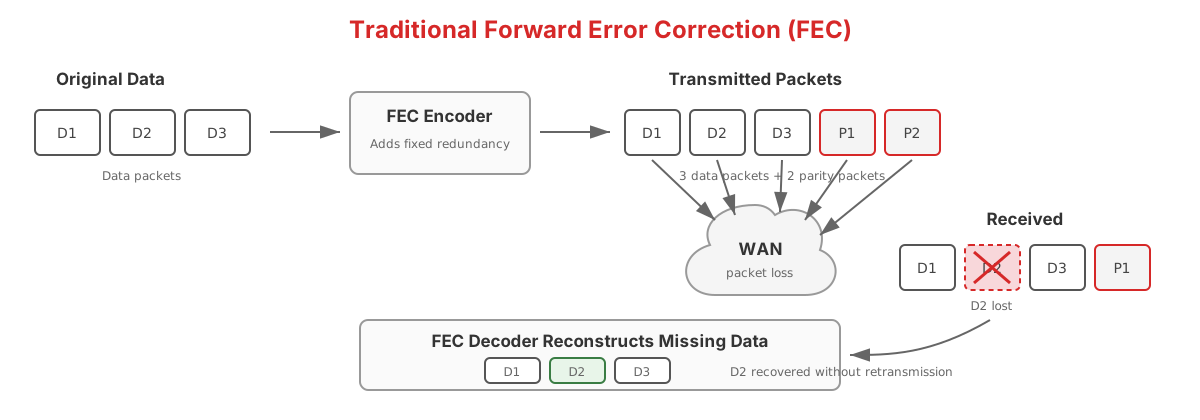
Convential FEC inserts additional checksums to avoid restransmissions
Forward Error Correction can be implemented at different levels of sophistication. Conventional FEC applies a predetermined amount of redundant or parity information to a data stream, providing the receiver with enough information to reconstruct packets lost in transit. While effective, this creates a trade-off: greater protection against packet loss requires greater bandwidth overhead, even when network conditions are good. Adaptive FEC extends this approach by varying the amount of redundancy according to current network conditions and application requirements. Rather than treating FEC as a fixed overhead, an adaptive implementation can increase protection when loss occurs and reduce it when the path is performing well, preserving bandwidth while still providing protection when it is needed. EdgeConnect uses this adaptive approach within its path-conditioning and link-bonding architecture.
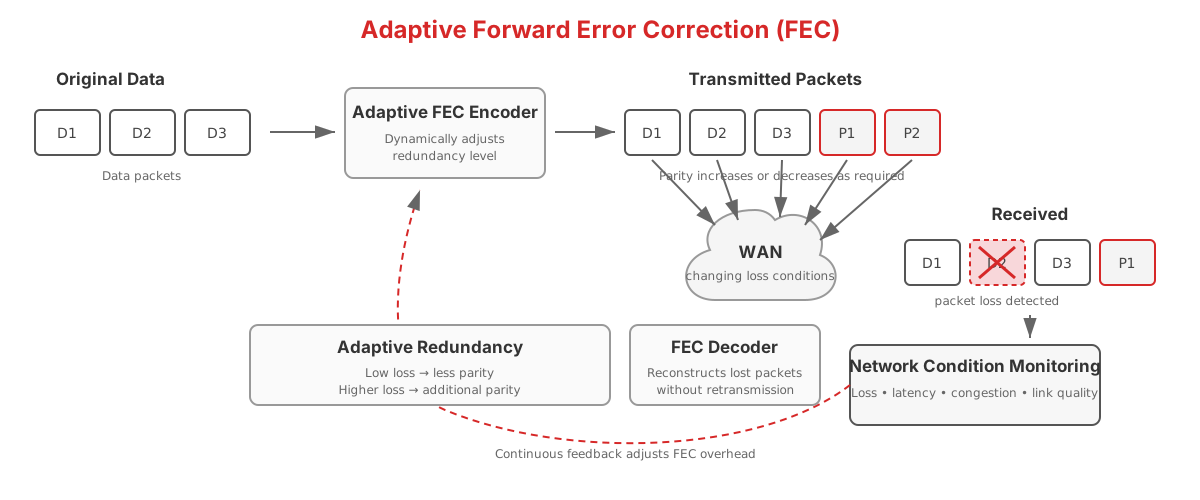
Adaptive FEC adjusts checksums to account for real-time measures of packet loss and latency
Controlling FEC Behaviour
Forward Error Correction is not simply an on-or-off function. Its effectiveness depends on how aggressively redundancy is generated, how quickly the system responds to changing packet-loss conditions, and how much additional bandwidth can be consumed in the process. These controls allow FEC behaviour to be tuned to the characteristics of the application and the WAN.
FEC Operating Mode
FEC can typically be disabled, enabled at a fixed level, or operated dynamically. A fixed configuration applies a predetermined amount of redundancy regardless of current network conditions. An adaptive configuration increases or decreases FEC overhead in response to observed packet loss, allowing additional protection to be applied only when it is required.
FEC Ratio
The FEC ratio determines how much redundant parity information is generated in relation to the original traffic. A more aggressive ratio provides greater ability to reconstruct lost packets, but also consumes more WAN bandwidth. Lower levels of redundancy reduce overhead, but provide less protection when loss rates increase.
The objective is therefore not to generate the maximum possible amount of FEC, but to generate enough redundancy to recover expected packet loss without consuming unnecessary link capacity.
Minimum and Maximum FEC Levels
Where adaptive FEC is used, minimum and maximum limits can be applied to constrain the amount of redundancy that the system is permitted to generate. These limits prevent the algorithm from either reducing protection below an acceptable level or allowing FEC overhead to consume an excessive proportion of the available bandwidth.
FEC Wait Time
FEC generation also involves a timing decision. The system must collect sufficient data before generating the corresponding parity information. A shorter FEC wait time can provide faster recovery behaviour, but may increase the amount of FEC traffic generated. A longer wait time may reduce overhead, but can delay the availability of recovery information.
This creates a trade-off between responsiveness, protection and bandwidth efficiency, particularly for latency-sensitive applications.
Application and Policy-Based Control
Different applications have different tolerance for packet loss, latency and additional bandwidth overhead. FEC can therefore be applied according to business or application policy rather than treating every flow identically.
- Real-time voice and video traffic may justify more aggressive protection.
- Interactive applications may require a balance between recovery and latency.
- Bulk data transfers may tolerate occasional retransmission and require less FEC.
- Non-critical traffic may operate without FEC where bandwidth efficiency is more important.
Measuring FEC Effectiveness
An important operational control is the ability to compare packet loss before and after FEC processing. Pre-FEC loss shows the underlying quality of the WAN path, while post-FEC loss shows how much unrecovered loss is ultimately presented to the application.
This distinction allows engineers to determine whether FEC is providing useful protection, whether additional redundancy is required, or whether the underlying link impairment is too severe for FEC alone to compensate effectively.
Summary - Forward Error Correction
Forward Error Correction (FEC) improves WAN performance by adding redundant information that allows lost packets to be reconstructed without retransmission. This is particularly important on higher-latency links, where even modest packet loss can significantly reduce TCP throughput as congestion-control mechanisms respond to missing packets. Traditional FEC applies a predetermined level of redundancy, providing predictable protection but potentially adding unnecessary overhead when network conditions are good or insufficient protection when they deteriorate.
Adaptive FEC extends this approach by continuously responding to changing network conditions. Redundancy can be increased as packet loss rises and reduced when link quality improves, balancing recovery effectiveness against bandwidth overhead. By recovering packets before loss propagates to higher-layer protocols such as TCP, adaptive FEC can help applications make more effective use of the available WAN capacity, particularly across links where latency, variable loss, and changing network conditions would otherwise constrain performance.
Forward Error Correction is one component in Advanced SD-WAN implementaions to deliver path conditioning to increase application performance, even in challenging netowrk environments.
Contact Us Please contact Hararei for an in-depth discussion on using any of our Cloud or Cybersecurity products or services