Thin Branch Architecture
Traditional Branches Carry Too Much Infrastructure
Many branch offices still operate with infrastructure models designed for a very different era. Routers, firewalls, WAN appliances, local servers, private circuits and other dedicated systems are deployed at each location, creating a large operational footprint that must be purchased, configured, monitored, patched and eventually replaced.
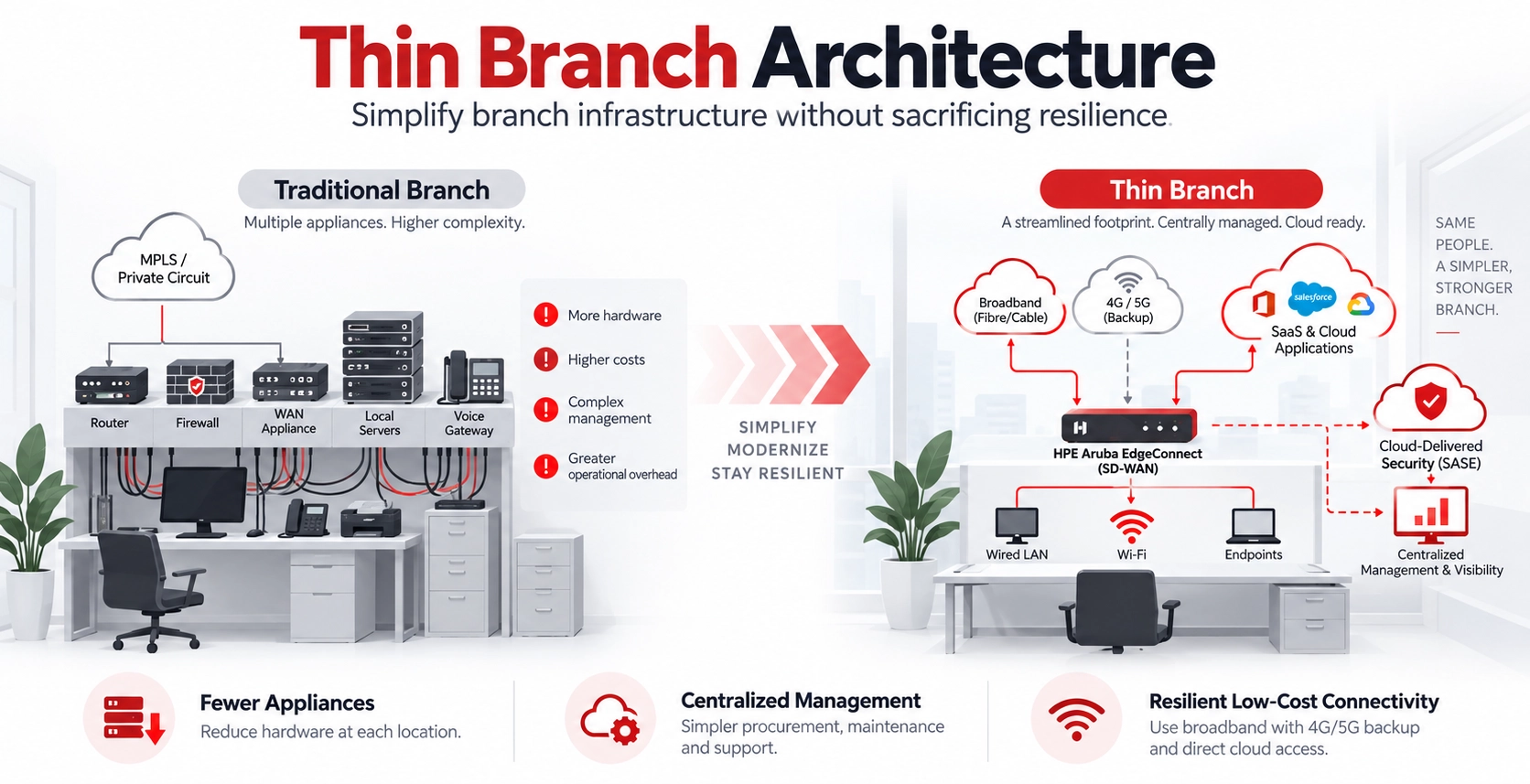
As applications move to SaaS and cloud platforms, this model becomes increasingly inefficient. Branch traffic is often still backhauled through centralized data centers, while local infrastructure remains in place to support functions that no longer need to reside at the branch.
The result is higher cost, greater operational complexity and more dependence on local support. Each additional appliance, circuit and configuration becomes another potential point of failure, while maintaining consistency across dozens or hundreds of locations becomes increasingly difficult.
A modern branch architecture should retain only the infrastructure that genuinely needs to be local, while moving management, security and application delivery toward centralized and cloud-based services wherever practical.
What Is a Thin Branch?
A thin branch is a branch office designed to operate with the minimum amount of infrastructure required on site. Instead of recreating a small data center at every location, networking, security, applications and management functions are centralized or delivered from cloud-based platforms wherever practical.
The objective is not simply to remove hardware. It is to reduce operational complexity while preserving the connectivity, security and resilience the branch requires. Local infrastructure is retained where it provides a clear operational benefit, while functions that can be delivered centrally are moved away from the branch.
In a thin branch architecture, the local footprint may be reduced to resilient WAN connectivity, SD-WAN, switching and wireless access, with security policy, application access and operational management delivered through centralized or cloud-based services.
This creates a simpler and more consistent branch environment that is easier to deploy, support and scale across a distributed organization.
Eliminate High Branch Operational Costs by Using Reliable SD-WAN Services
A significant source of ongoing operational costs for widely distributed enterprises is the expense associated with running branch operations. Whether it is bank branches, retail stores, government offices or insurance agencies, the costs associated with the branch network are a significant portion of the cost structure of the distributed enterprise. The advent of SD-WAN has changed this paradigm, with the savings extending to more than just the savings on network bandwidth.
The branch network is a critical asset, and usually, an outage in the branch network is a source of frustration for customers and staff, and possibly a loss of revenue from the affected locations.
The costs include more than just the cost of the actual wide area network (WAN), but extend to personnel support costs at the remote locations, to branch routers and other branch support equipment.
For the WAN costs, companies were previously forced between the choice of using a private network (leased lines, MPLS) or an IPSEC network over the public Internet. A private network, such as the one used to connect the sites depicted below, has an astronomical cost. An IPSEC network would have very high complexity and serviceability costs. Undertaking a network transformation based on SD-WAN can help address the WAN costs, but how else can companies further reduce costs and increase reliability?
From Traditional Branch to Thin Branch
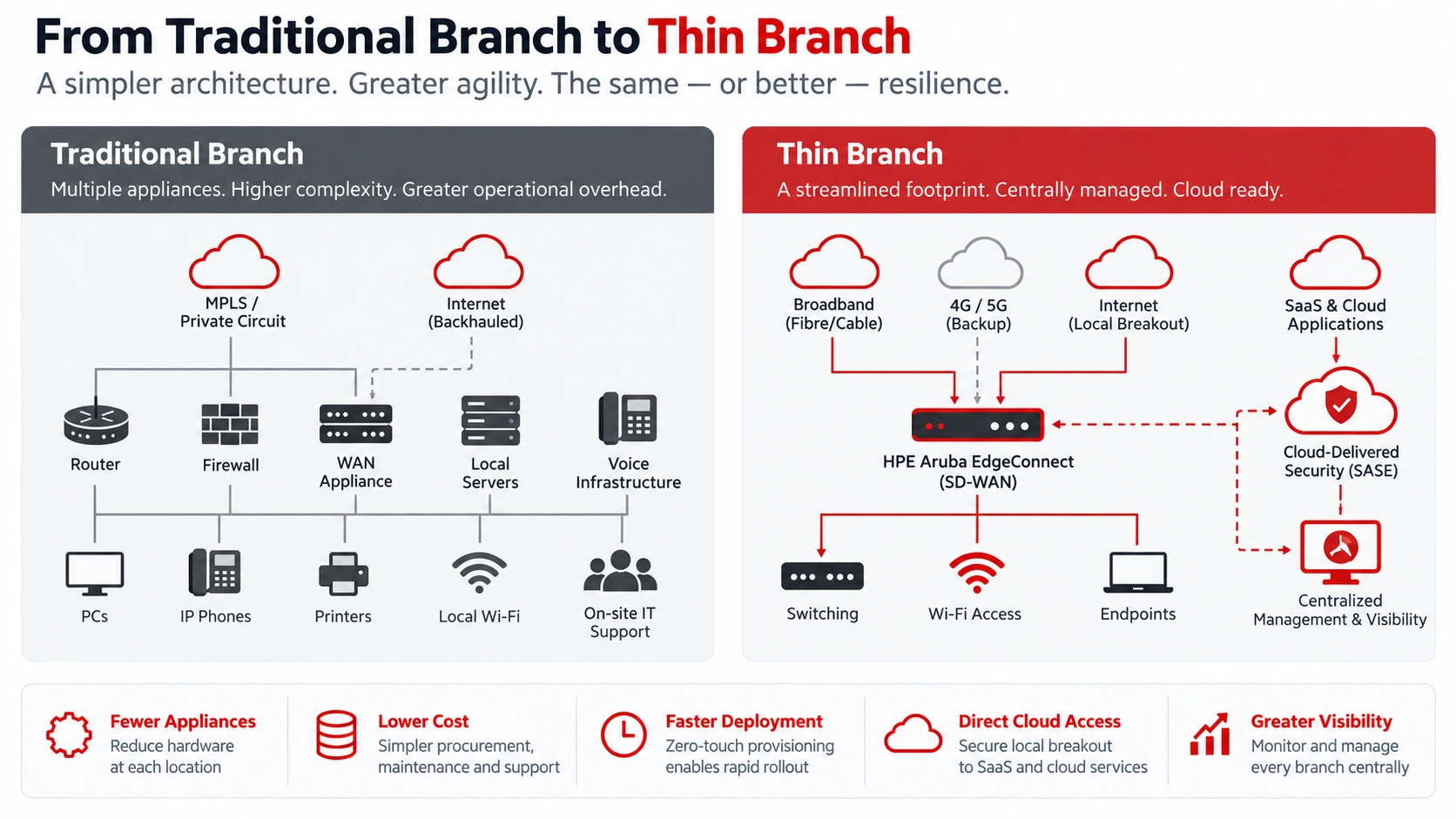
Traditional branch environments are often built from multiple dedicated components: private WAN circuits, routers, firewalls, local servers and other infrastructure that must be deployed and managed at every location. As the number of branches grows, so does the operational burden.
A thin branch changes that model by consolidating network functions, using resilient internet-based connectivity and moving applications, security and management toward centralized or cloud-delivered services. The branch retains what must remain local, while unnecessary infrastructure is removed.
The result is a simpler branch architecture with fewer appliances, faster deployment, improved visibility and a lower ongoing support requirement—without giving up the resilience or control the business depends on.
Reduce the Branch Hardware Footprint
One of the core principles of thin branch architecture is to remove infrastructure that no longer needs to exist at every location. Traditional branches often accumulate dedicated routers, firewalls, WAN appliances, local servers and other systems that each require procurement, configuration, maintenance and eventual replacement.
By consolidating network functions and moving suitable services to centralized or cloud-delivered platforms, the branch can be reduced to a much smaller set of essential components. In many environments, this means resilient WAN connectivity, SD-WAN, switching and wireless access, with applications, security policy and management delivered remotely.
This smaller footprint reduces hardware cost and support overhead, but the larger benefit is operational simplicity. Fewer devices mean fewer configurations to maintain, fewer points of failure and a more consistent architecture across every branch.
The goal is not to eliminate local infrastructure indiscriminately. It is to keep only what delivers a clear operational benefit at the branch and remove everything else that can be delivered more efficiently from elsewhere.
Use Multiple Low-Cost Transports for Resilience
A thin branch does not need to depend on a single expensive private circuit to achieve reliable connectivity. Modern SD-WAN can combine multiple transport types, allowing organizations to use broadband, dedicated internet access, 4G/5G and other available services as part of a resilient branch design.
Traffic can be steered dynamically across available links according to application requirements, link quality and business policy. If one connection degrades or fails, critical traffic can be moved to another path without requiring manual intervention.
This gives organizations greater flexibility in how each location is connected. Large or business-critical branches can use multiple diverse circuits, while smaller locations can use simpler combinations of broadband and cellular connectivity without forcing every branch into the same WAN design.
The result is a network that can reduce dependence on costly legacy circuits while maintaining — and in many cases improving — branch availability.
With sufficient speed and resilience in the network, all branch IT equipment may also be removed over time, with the branch relying on connectivity to regional or head office for all support functions. File servers and routers, and even voice systems may be replaced with a reliable VOIP system running over SD-WAN. The branch may also consume Internet-based services directly via local breakout.
The level of redundancy can be tailored to the criticality of the branch, with more critical branches potentially have 3 or more underlying transports, but a small sub-agency, for example, having just 1. The key here though is that the secure overlay network is presented to the branch in the same format, greatly reducing configuration complexity at the end points.
Visibility of the branch network is constant, and includes historical data so that if a branch reported a network issue after the event, real data is available to allow determination of root cause with the telecoms provider. There is complete visibility into current and historical network conditions. As multiple telecom providers may be used, the customer is free to choose which providers give the best service. The customer regains buying power with the telecoms provider that may have been lacking.
By removing all branch equipment, local IT support requirements are also removed, further reducing costs. IT skill requirements for branch staff is eliminated, which reduces training and branch operational documentation requirements.
In addition to the dramatic reduction in cost, the addition of an "always on" and performant network connection allows new possibilities, such as better real-time tracking of sales and collection of customer feedback.
It is worth noting that moving to a thin branch architecture can be evolutionary, with a gradual adoption at strategic locations, or revolutionary, with a wholesale rollout to a branch network of thousands of branches. The speed of adoption is up to you and your appetite for risk
Centralize Operations With Zero-Touch Provisioning
Thin branch architecture is not only about reducing hardware. It is also about reducing the amount of hands-on work required to deploy and operate each location.
With centralized management and zero-touch provisioning, branch devices can be shipped directly to a site, connected to available WAN services and brought online with pre-defined configurations and policies. This removes much of the need for skilled engineers to travel to each branch for installation and configuration.
Once deployed, network policy, software updates, configuration changes and operational monitoring can be managed centrally across the entire branch estate. This helps maintain consistency, reduces configuration drift and makes it easier to apply changes across many locations at once.
For organizations with distributed offices, retail sites or remote facilities, this can significantly reduce deployment time and ongoing support effort while making branch operations more standardized and predictable.
Give Branches Direct Access to Cloud and SaaS
Traditional branch networks were often designed around centralized data centers, with internet and application traffic backhauled across private WAN links before reaching its destination. That model becomes inefficient as more business applications move to SaaS and public cloud platforms.
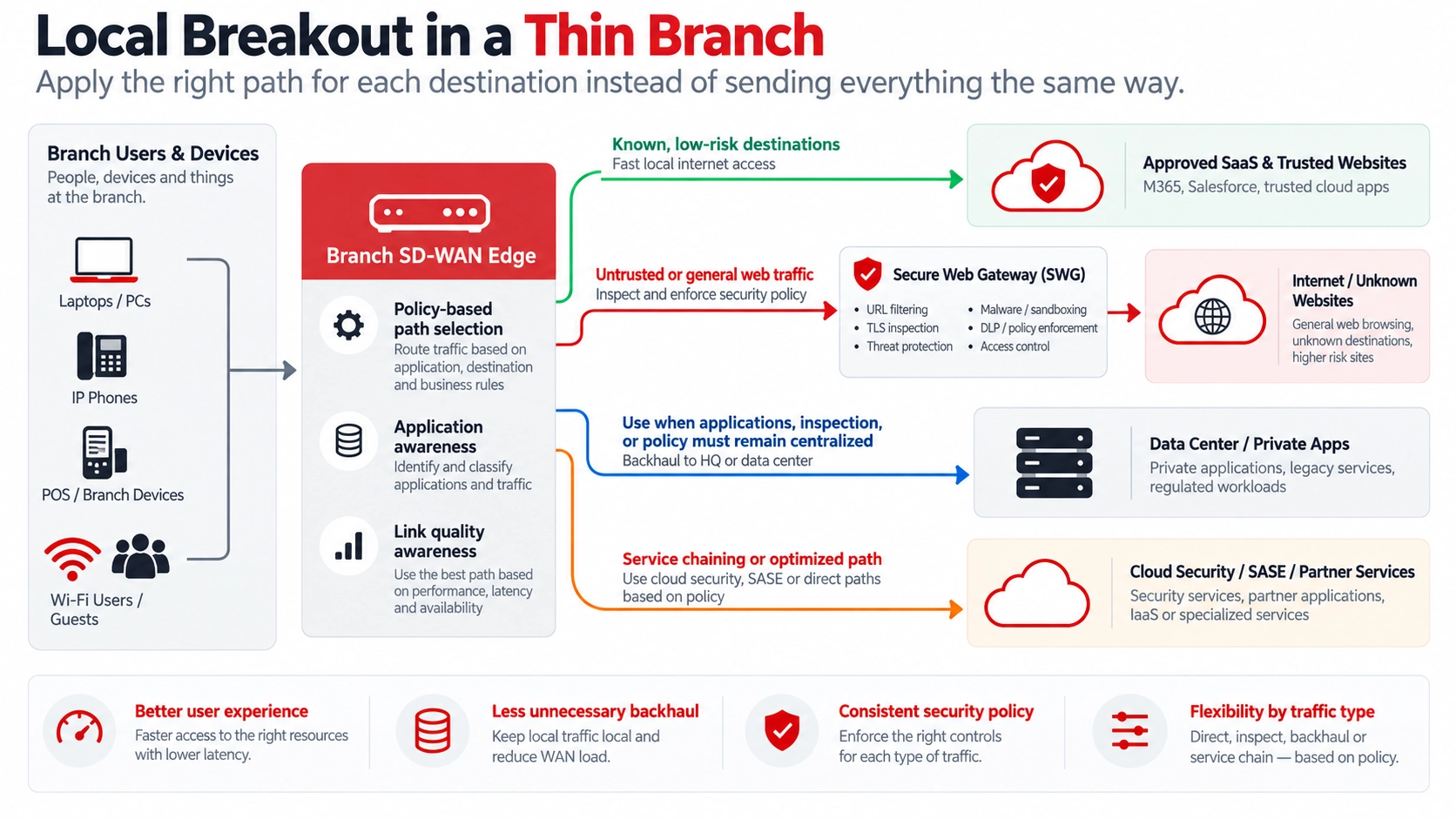
A thin branch can provide direct local access to cloud and internet services while still applying centralized security and network policy. This reduces unnecessary backhaul, shortens the path to applications and can improve user experience for services such as Microsoft 365, Salesforce and other cloud-based platforms.
Local internet breakout also allows organizations to make better use of readily available broadband services instead of forcing all branch traffic through centralized infrastructure. Security controls can be delivered through cloud-based platforms, while SD-WAN determines the best available path for each application.
The result is a branch architecture that is better aligned with where modern applications actually reside: in the cloud, rather than exclusively in the data center.
Improve Visibility Across Every Branch
Distributed branch environments are difficult to manage when network performance and security activity can only be understood one site at a time. A thin branch architecture improves this by bringing operational and cybersecurity visibility into a centralized management model.
IT teams can monitor WAN availability, latency, packet loss, jitter, application performance and link utilization across the entire branch estate. At the same time, cloud-delivered security platforms can provide visibility into web activity, application usage, blocked threats, policy violations and other security events generated by branch users and devices.
This combined view makes it easier to determine whether a problem is caused by the local network, an ISP connection, an application path, a security policy or potentially malicious activity. Application-aware and security-aware telemetry can also help identify unexpected traffic patterns, unauthorized applications, risky destinations and branch devices behaving outside normal policy.
Centralized visibility reduces the need to troubleshoot branches individually and gives network and security teams a consistent view across every location. Problems can be identified faster, recurring issues become easier to spot, and cybersecurity events can be investigated with greater context across the wider enterprise environment.
A Thin Branch Does Not Mean a Fragile Branch
Reducing the amount of infrastructure at a branch does not mean reducing resilience. In many cases, a simpler architecture can actually improve availability by removing unnecessary devices, avoiding single-purpose appliances and using multiple independent connectivity options.
SD-WAN can continuously monitor the quality of available links and steer traffic according to application requirements and real-time network conditions. Broadband, dedicated internet and 4G/5G services can be combined so that the failure or degradation of one path does not automatically isolate the branch.
Resilience can also be matched to the importance of each location. A small office may require only broadband with cellular backup, while a critical branch can use multiple diverse circuits, redundant network equipment and alternative paths to key applications and services.
Cloud-delivered security and centralized management further reduce dependence on complex local infrastructure. The objective is not simply to make the branch smaller, but to remove unnecessary components while preserving the redundancy, security and operational control needed to keep the business running.
The Economics of Thin Branch
The financial case for thin branch architecture goes beyond replacing MPLS with lower-cost internet connectivity. The larger opportunity is to reduce the total cost of operating distributed locations by simplifying the infrastructure, support model and lifecycle requirements at each branch.
Fewer appliances can mean lower capital expenditure, fewer maintenance contracts and less equipment to refresh over time. Centralized management and zero-touch provisioning can reduce travel, field-engineering and deployment costs, while a more standardized branch design can lower the effort required for ongoing support.
Organizations can also gain greater flexibility in how connectivity is purchased. Instead of relying on the same expensive WAN design everywhere, each branch can use the combination of broadband, dedicated internet and cellular services that best matches its business importance, performance requirements and local availability.
The result is a branch model that can reduce both direct technology costs and the operational overhead associated with managing a large distributed estate. The economics improve further as the number of branches increases, because simplification and standardization can be applied consistently across the entire environment.
Adopt Thin Branch Incrementally
Moving to a thin branch architecture does not have to be a large-scale replacement program. Most organizations can make the transition gradually, using existing technology refresh cycles, carrier contract renewals and branch priorities to determine where to start.
Different adoption paths can be used depending on the current environment:
Start With WAN Transformation
Replace legacy private WAN services with SD-WAN and a mix of broadband, dedicated internet and cellular connectivity. This can reduce telecom costs while introducing centralized policy, application-aware routing and greater resilience.
Quick wins: add a secondary internet or 4G/5G path, move selected SaaS traffic to local breakout, and use SD-WAN visibility to identify poorly performing or unnecessarily expensive circuits.
Start With Hardware Refresh
Use router, firewall or branch appliance refresh cycles as an opportunity to simplify the local architecture rather than replacing each device on a like-for-like basis. Functions can be consolidated or moved to centralized and cloud-delivered platforms where appropriate.
Quick wins: identify appliances approaching end of support, eliminate redundant devices, and avoid renewing maintenance contracts for functions that can be delivered elsewhere.
Start With Cloud and SaaS Adoption
Branches that increasingly rely on Microsoft 365, Salesforce and other SaaS platforms are natural candidates for a thinner architecture. Direct cloud access can reduce unnecessary backhaul and make the branch network better aligned with where applications now reside.
Quick wins: identify high-volume SaaS traffic currently being backhauled, introduce trusted local breakout for suitable destinations, and apply cloud-delivered security to internet-bound traffic.
Start With New or Relocated Branches
New offices provide an opportunity to deploy a thin branch design from the outset without having to unwind an established legacy environment. The same approach can be used when existing offices are relocated or significantly refurbished.
Quick wins: avoid installing legacy routers and unnecessary local servers, use zero-touch provisioning, and design connectivity around internet and cellular services from day one.
Start With a Branch Segment
Organizations with many locations can select a repeatable branch type—such as small offices, retail sites or regional locations—and establish a standard thin branch architecture for that group before expanding further.
Quick wins: define a standard branch template, reduce configuration variation, simplify support procedures and use the initial deployment to validate cost, performance and operational assumptions.
The most effective migration path is usually the one that aligns thin branch adoption with changes the organization already needs to make. By combining transformation with existing refresh, expansion and contract-renewal activity, organizations can reduce risk while realizing benefits progressively.
Technology Enabling the Thin Branch
A thin branch is enabled by combining several technologies that reduce the amount of infrastructure required locally while preserving connectivity, security, control and visibility.
SD-WAN
SD-WAN provides the foundation for resilient branch connectivity. It can combine multiple transport types, apply application-aware routing, support local internet breakout and centralize WAN policy across the branch estate.
Cloud-Delivered Security
Secure web gateway, zero trust access and other SASE capabilities allow security controls to be delivered from the cloud rather than relying entirely on dedicated security appliances at each branch. Internet-bound traffic can be inspected and controlled consistently, while trusted destinations can use more direct paths where appropriate.
Centralized Switching and Wireless
Modern switching and Wi-Fi platforms simplify the remaining local infrastructure by providing centralized configuration, monitoring and policy management across distributed sites.
Zero-Touch Provisioning
New branch devices can be shipped directly to a location and brought online with centrally defined configurations and policies. This reduces deployment effort and limits the need for specialist engineering resources on site.
Centralized Visibility and Analytics
Network and security telemetry can be collected centrally to provide visibility into application performance, WAN health, user activity, security events and policy compliance across every branch.
Hararei works with technologies including HPE Aruba EdgeConnect SD-WAN and cloud-delivered security platforms such as Zscaler to build thin branch architectures that can be adapted to the size, criticality and operating requirements of each location.
Why Hararei for Thin Branch
Thin branch transformation is not simply a technology refresh. It requires decisions about what should remain local, what can move to cloud-delivered services, how branches should connect, how security should be applied and how the resulting environment will be operated over time.
Hararei brings practical enterprise experience across network transformation, SD-WAN, SASE, cloud connectivity and branch operations. We help customers design architectures around business requirements rather than forcing every location into the same technical model.
Our approach can include evaluating the current branch estate, identifying consolidation opportunities, designing resilient connectivity, planning migration paths, selecting and procuring technology, implementing the solution and providing ongoing Day 2 support.
Because we work across networking, cybersecurity and cloud platforms, we can help ensure that branch simplification does not create gaps between connectivity, security and operational visibility. The objective is a branch architecture that is simpler to run, easier to scale and aligned with the way the organization actually works.
Assess Your Branch Architecture
If your branch environment still depends on multiple appliances, expensive private circuits or extensive local support, there may be opportunities to simplify the architecture without compromising resilience or security.
Hararei can help assess your current branch estate, identify quick wins, develop a practical migration path and determine where SD-WAN, cloud-delivered security and centralized management can reduce complexity and operating cost.
Hararei are authorized channel partners for Aruba, with their EdgeConnect® products, and have experience with branch operations at scale, often in challenging conditions. Contact Hararei for a free briefing and demonstration of the Aruba SD-WAN solution for implementing a thin branch infrastructure.
Contact Us Please contact Hararei for an in-depth discussion on using any of our Cloud or Cybersecurity products or services