Secure Access to SAP with Zero Trust
SAP Migration Changes the Access Architecture
SAP applications sit at the center of critical business operations, including finance, procurement, manufacturing, supply chain, human resources and customer processes. They also contain some of the most sensitive information within the enterprise.
As organizations move from traditional SAP ECC environments toward SAP S/4HANA and RISE with SAP, the applications may move to the cloud, but the access architecture often remains rooted in traditional networking. Remote users, employees, consultants and partners are still frequently connected through VPNs or other network-centric access technologies.
This creates an unnecessary security problem. A user who only needs access to a specific SAP application should not need access to the network surrounding it.
Zero Trust Network Access changes that model by connecting an authorized user directly to an authorized SAP application, without extending the enterprise network to the user.
Replace Network Access with Application Access
Traditional VPNs establish connectivity between a user and a network. Zscaler Private Access takes a fundamentally different approach. Access is granted to the individual application rather than to the network on which the application resides.
When an authorized user requests access to SAP, ZPA evaluates identity, device posture and other policy conditions before establishing a secure connection between that user and the permitted SAP application.
Application-Specific Access
Users receive access only to the SAP applications they are authorized to use rather than broad network connectivity.
Identity-Based Policy
Access decisions can incorporate user identity, device posture, location and other contextual information.
Reduced Attack Surface
SAP applications do not need to be directly exposed to remote users or the public internet.
Limit Lateral Movement
Connecting users to applications rather than networks restricts the ability to move laterally if a user or device is compromised.
Native Zero Trust Access for RISE with SAP
Organizations migrating to RISE with SAP can extend the zero trust access model directly into the SAP-managed cloud environment.
Zscaler Private Access Application Connectors can be provisioned natively within the RISE with SAP environment. These connectors establish outbound connections to the Zscaler Zero Trust Exchange, allowing authorized users to reach SAP applications without requiring inbound network connectivity or exposing the applications through public IP addresses.
This creates a direct user-to-application architecture in which access is brokered according to identity and policy rather than by extending network access to the user. The model can support SAP applications as they move from legacy environments into SAP S/4HANA Private Cloud Edition within RISE with SAP.
Because the ZPA service is deployed within the SAP-managed RISE environment, secure access can be delivered without relying on traditional VPN connectivity or exposing SAP applications to inbound connections. SAP manages the underlying RISE infrastructure, while the customer retains control over its ZPA tenant, users and access policies.
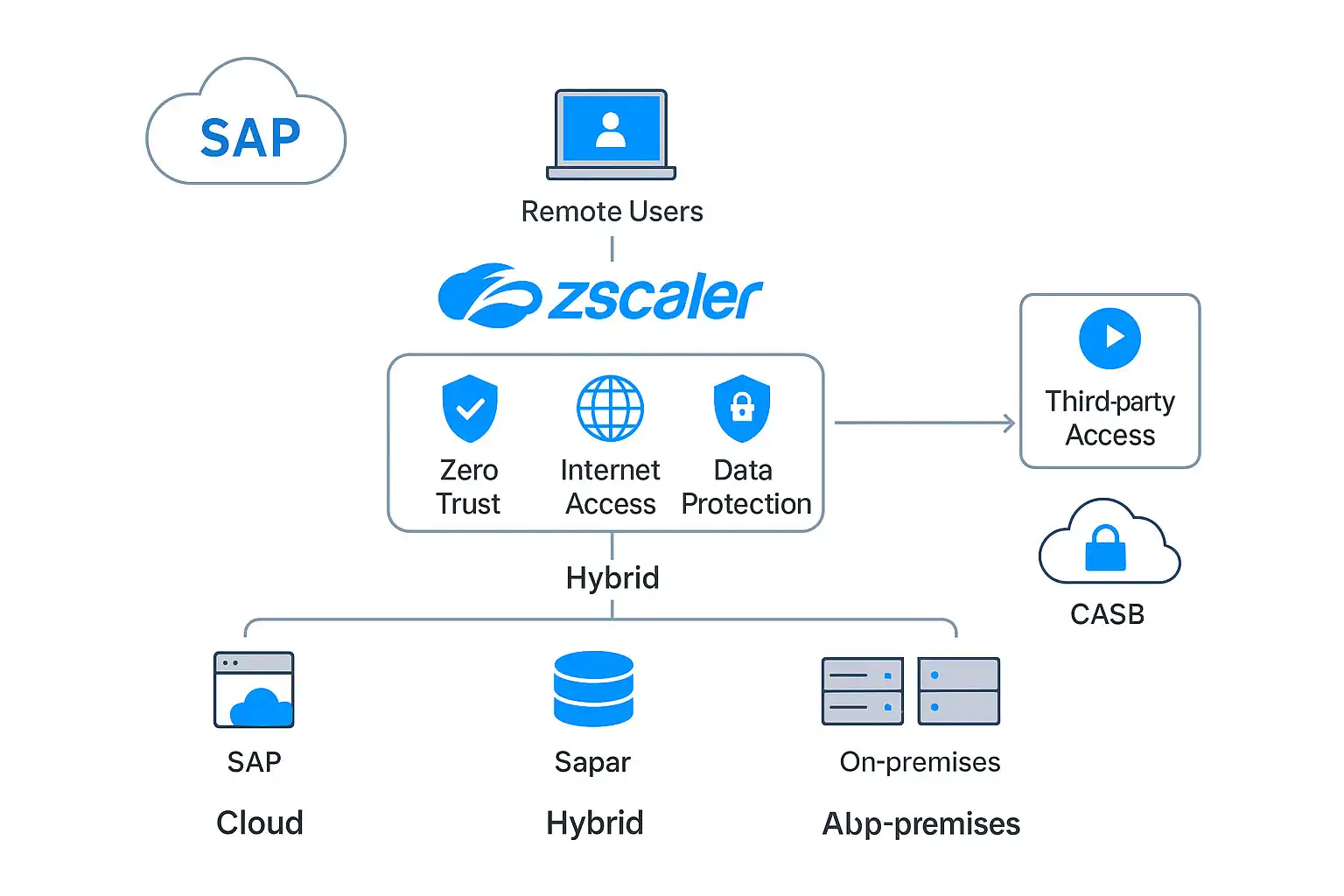
Learn More About ZPA for RISE with SAP
Download the Zscaler solution brief for a more detailed overview of the architecture, native integration, deployment model and secure access options for employees and third parties.
Maintain Secure Access Throughout the SAP Migration
SAP transformation rarely happens in a single step. Organizations may operate legacy SAP systems, cloud-hosted workloads and RISE with SAP simultaneously while applications and business processes are migrated.
ZPA can provide a consistent access layer across these environments. Users continue to access the SAP applications they require while the underlying application location changes.
This allows the SAP migration and the access transformation to be managed independently. Organizations can progressively move applications to S/4HANA and RISE with SAP without repeatedly redesigning remote-access connectivity for their users.
Secure Access for Employees, Partners and Consultants
SAP environments frequently need to be accessed by more than managed corporate users. Systems integrators, consultants, suppliers and other third parties may also require access to specific applications.
Managed Employees
Zscaler Client Connector provides identity-aware access from managed devices. Security policy can consider both the user and the security posture of the device before SAP access is permitted.
Partners and Unmanaged Devices
Browser-based access can provide authorized third parties with access to selected SAP applications without requiring a VPN or providing access to the surrounding network.
Protect Sensitive SAP Data
Controlling who can reach an SAP application is only part of the security requirement. Organizations must also control how sensitive information can be used once access has been granted.
Zscaler's integrated data protection capabilities can inspect SAP application traffic and apply policies designed to identify and prevent the unauthorized movement of sensitive information.
For higher-risk third-party or unmanaged-device scenarios, Cloud Browser Isolation can provide additional control by allowing users to interact with an application while restricting actions such as file downloads, uploads, clipboard operations or exposure of sensitive information.
Reduce the SAP Attack Surface
Traditional remote access technologies expose more of the environment than most SAP users actually need. Zero trust access reduces that exposure by limiting connectivity to the specific applications a user is authorized to access.
No Inbound Exposure
SAP applications do not need to accept inbound connections from remote users or be exposed through public IP addresses.
Least-Privilege Access
Users are connected only to the SAP applications they are authorized to use rather than being placed on the surrounding network.
Application Isolation
Separating user-to-application connections helps prevent a compromised session from becoming a path to other applications.
Reduced Lateral Movement
Because users are not granted network-level access, the ability to discover and move laterally through the SAP environment is significantly reduced.
Modernize SAP Access as You Move to the Cloud
Moving SAP applications to S/4HANA and RISE with SAP is an opportunity to modernize the way users, partners and third parties connect to critical business systems.
Hararei can help assess your existing SAP access architecture, identify where VPN-based connectivity can be replaced, and design a zero trust access model using Zscaler Private Access.
Contact Us Please contact Hararei for an in-depth discussion on using any of our Cloud or Cybersecurity products or services