Managed Detection & Response
Strengthen Security Operations Without Building a Full SOC

Why Managed Detection and Response Is Needed
Modern organizations generate large volumes of security data from endpoints, identities, networks, cloud platforms, applications and security controls. The challenge is no longer simply collecting alerts, but determining which events represent genuine threats, understanding how an attack is developing, and responding quickly enough to prevent material impact.
Many security teams struggle to maintain this level of continuous coverage. Alert volumes can overwhelm internal resources, specialist security analysts are difficult to recruit and retain, and effective monitoring must continue outside normal business hours. Even organizations with strong endpoint protection, firewalls and cloud security controls can remain exposed if suspicious activity is not investigated and acted upon promptly.
Managed Detection and Response (MDR) addresses this operational gap by combining security technology, continuous monitoring and expert analysis. Rather than leaving customers to review isolated alerts themselves, MDR services investigate suspicious activity, correlate events across multiple data sources, identify genuine threats and support or initiate the actions required to contain and remediate an incident.
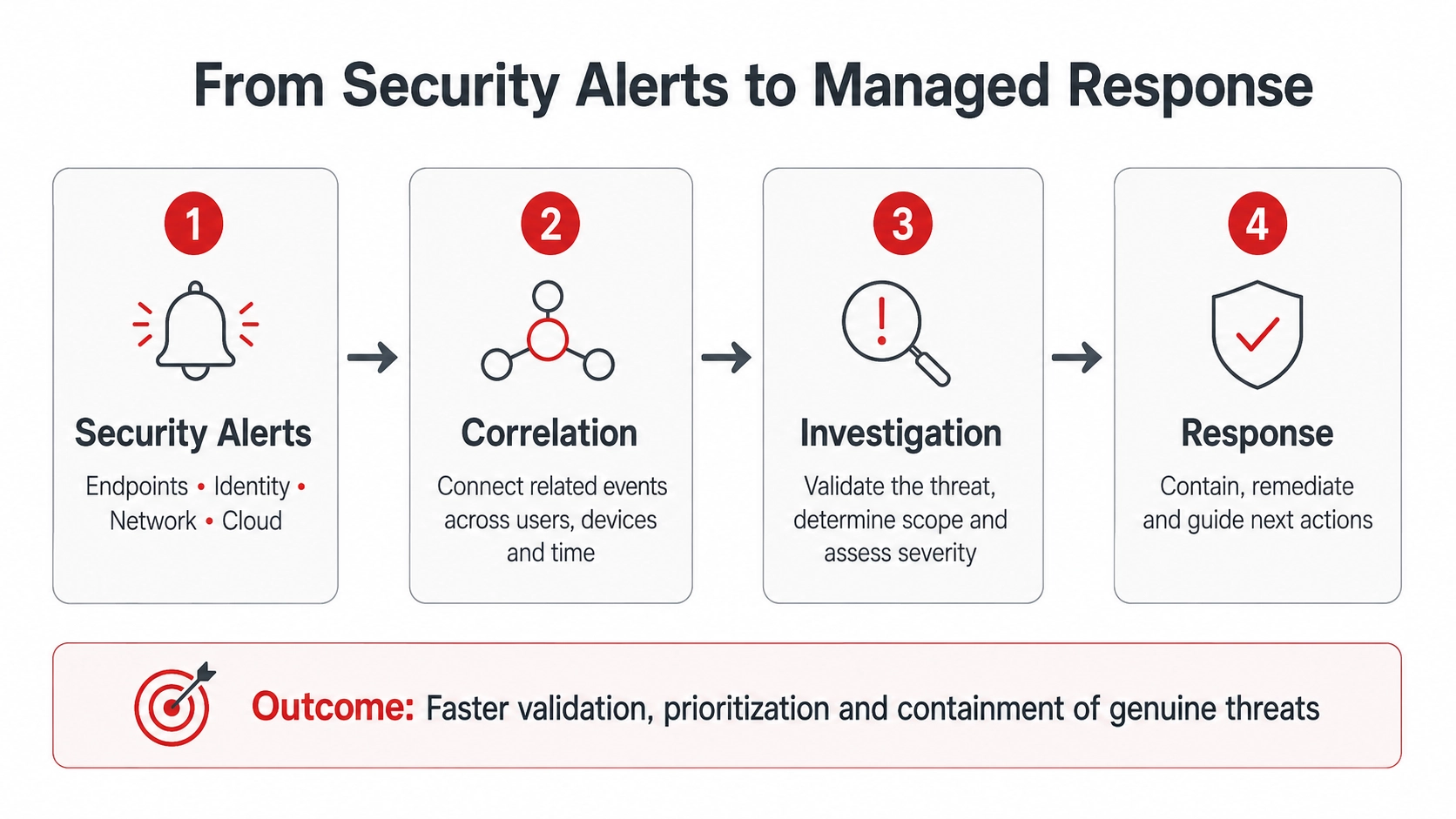
From Security Alerts to Managed Response
Security tools generate alerts when they detect activity that may indicate compromise, but those alerts still need to be validated, prioritized and investigated. A single alert rarely provides enough information to determine whether an event is benign, suspicious or part of a broader attack.
MDR services add the analysis and response layer around those detections. Security telemetry is correlated across relevant sources, suspicious activity is investigated, and analysts determine whether an incident is genuine, how far it has progressed and what systems or users may be affected.
Where malicious activity is confirmed, MDR provides the context and guidance needed to contain the threat and begin remediation. Depending on the service model and available integrations, the provider may also take direct response actions, such as isolating an endpoint, disabling access or supporting the customer through containment.
The goal is to reduce the time between initial detection and effective response, while ensuring that internal teams are not required to investigate every alert themselves.
Why Detection Alone Is Not Enough
Security technologies such as endpoint protection, firewalls, identity platforms and cloud security controls are highly effective at identifying suspicious activity, but detection by itself does not resolve an incident. A security alert may indicate anything from a benign administrative action to the early stages of a significant compromise, and determining the difference requires context, investigation and judgement.
In many environments, this creates an operational gap between the technology generating the alert and the people responsible for acting on it. If alerts are not reviewed quickly, correlated with related events and prioritized according to business impact, genuine threats can remain active while security teams work through large volumes of lower-value notifications.
MDR is designed to close this gap. Instead of treating each alert as an isolated event, MDR combines telemetry from multiple sources, applies detection logic and threat intelligence, and uses analyst investigation to establish whether malicious activity is taking place. The objective is not simply to generate more alerts, but to identify the smaller number of events that require action and provide the context needed to respond effectively.
This distinction is particularly important for organizations that already have EDR, SIEM or other security monitoring technologies in place. These platforms can provide powerful detection capabilities, but without the operational processes and skilled resources required to investigate and respond continuously, much of their value can remain unrealized.
Building Continuous Threat Visibility
Effective MDR depends on having sufficient visibility across the technologies where attacker activity can appear. Endpoint telemetry remains important, but modern attacks frequently move across identities, cloud services, applications and network connections. A threat that appears insignificant in one system may become much more serious when correlated with activity from several different sources.
MDR services therefore collect and analyze telemetry from multiple security controls and platforms to build a broader view of suspicious behavior. This can include endpoint detection and response, identity systems, firewalls, cloud infrastructure, email security, SaaS applications and other relevant data sources. The objective is to identify relationships between events that would otherwise remain isolated.
Continuous visibility is particularly important for detecting attacks that develop gradually. Credential theft, privilege escalation, lateral movement and data exfiltration may occur over hours or days and may not trigger a single definitive alert. By correlating activity over time, MDR can identify patterns that are more indicative of a genuine compromise.
The quality of an MDR service therefore depends not only on the number of data sources it can ingest, but on how effectively that information is normalized, correlated and investigated. Broad telemetry without meaningful analysis can simply create more noise; the value comes from turning that visibility into actionable threat intelligence.
The Role of Human Security Analysts
Automation, analytics and artificial intelligence can identify suspicious patterns, prioritize events and reduce the volume of security data that requires manual review. They are essential to operating MDR at scale, but they do not remove the need for experienced security analysts.
Many security events are ambiguous and require context to determine whether they represent malicious activity. Analysts assess user behavior, system relationships, business impact and the sequence of events surrounding an alert. This judgement is particularly important when activity resembles legitimate administrative behavior or when an attacker deliberately attempts to remain below automated detection thresholds.
Human analysts also play a critical role once a threat has been confirmed. They can determine the likely scope of compromise, identify affected users or systems, recommend containment actions and help prioritize the response according to risk. In more advanced MDR services, analysts may also perform proactive threat hunting to look for indicators of compromise that have not generated a conventional alert.
The strongest MDR model therefore combines technology-driven detection with human investigation. Automation provides speed and scale, while experienced analysts provide the context and judgement needed to distinguish genuine threats from noise and guide an effective response.
MDR vs EDR vs SIEM vs SOC
MDR is often discussed alongside EDR, SIEM and SOC services, but these terms describe different parts of the security operations model. Understanding the distinction is important because an organization can deploy strong security technology without necessarily having the operational capability to investigate and respond to threats continuously.
Endpoint Detection and Response (EDR) is a security technology focused primarily on endpoint activity. It monitors devices for suspicious behavior, generates detections and can provide response capabilities such as isolating a compromised endpoint. EDR is an important source of telemetry for MDR, but deploying EDR does not by itself provide continuous investigation or managed response.
Security Information and Event Management (SIEM) platforms collect and analyze logs and security events from multiple systems. They provide centralized visibility, correlation, alerting and reporting, and are commonly used as part of a broader security operations architecture. A SIEM can identify potential incidents, but it still requires skilled resources to maintain detection logic, investigate alerts and coordinate response.
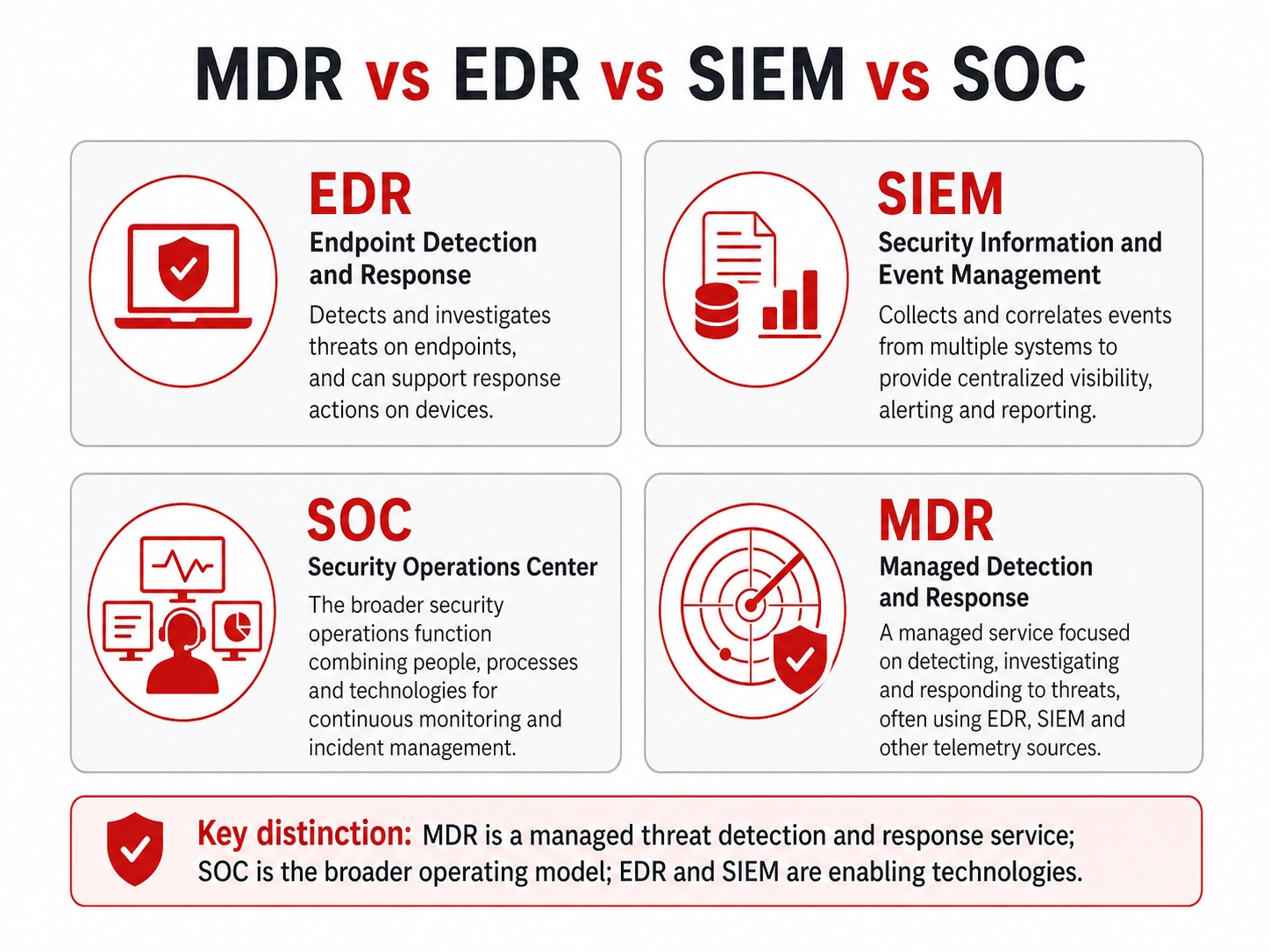
A Security Operations Center (SOC) is the broader operational function responsible for monitoring and managing security events. A SOC typically combines people, processes and technologies such as SIEM, EDR and threat intelligence, and may also perform threat hunting, incident coordination, reporting and other security operations activities.
Managed Detection and Response (MDR) is a managed service focused specifically on detecting, investigating and responding to threats. It can use EDR, SIEM and other security technologies as data sources, while providing the analysts and operational processes needed to turn detections into investigated incidents and response actions. For many organizations, MDR provides this capability without requiring them to build and staff a complete 24x7 SOC internally.
Response and Containment
Once malicious activity has been confirmed, the priority shifts from detection and investigation to limiting the attacker’s ability to cause further damage. Effective MDR therefore includes a defined response process that helps the customer contain the threat, protect affected systems and begin remediation as quickly as possible.
Response actions can vary depending on the nature of the incident and the integrations available to the MDR provider. Typical actions may include isolating compromised endpoints, disabling or resetting affected user accounts, blocking malicious connections, revoking sessions, restricting access to systems or applications, and identifying additional assets that may require investigation.
The MDR provider also helps establish the scope and severity of the incident so that response activity can be prioritized appropriately. A single compromised endpoint may require a very different response from an attack involving privileged credentials, lateral movement or potential data exfiltration.
In some MDR models, analysts provide detailed containment guidance for the customer’s internal team to execute. More integrated services may be able to take approved response actions directly through endpoint, identity, firewall or other security platforms. In both cases, the objective is the same: reduce dwell time, contain the threat quickly and support an orderly return to normal operations.
Using Arctic Wolf for Managed Detection and Response
Hararei uses Arctic Wolf to provide customers with a managed detection and response capability built around continuous monitoring, investigation and guided response. Arctic Wolf combines security telemetry from multiple sources with its cloud-native security operations platform and dedicated security operations expertise.
The service is designed to identify suspicious activity across endpoints, identities, networks, cloud environments and other connected systems, then correlate and investigate that activity to determine whether it represents a genuine threat. This helps reduce the volume of alerts that customers must review internally and focuses attention on incidents that require action.
Arctic Wolf also provides access to experienced security analysts who investigate threats, provide context around confirmed incidents and work with customers through containment and remediation. This operational model is particularly valuable for organizations that need 24x7 security coverage but do not want to build and staff a complete internal SOC.
By combining MDR technology with ongoing analyst engagement, Arctic Wolf provides customers with a structured way to improve detection and response maturity while retaining visibility into their own security environment.
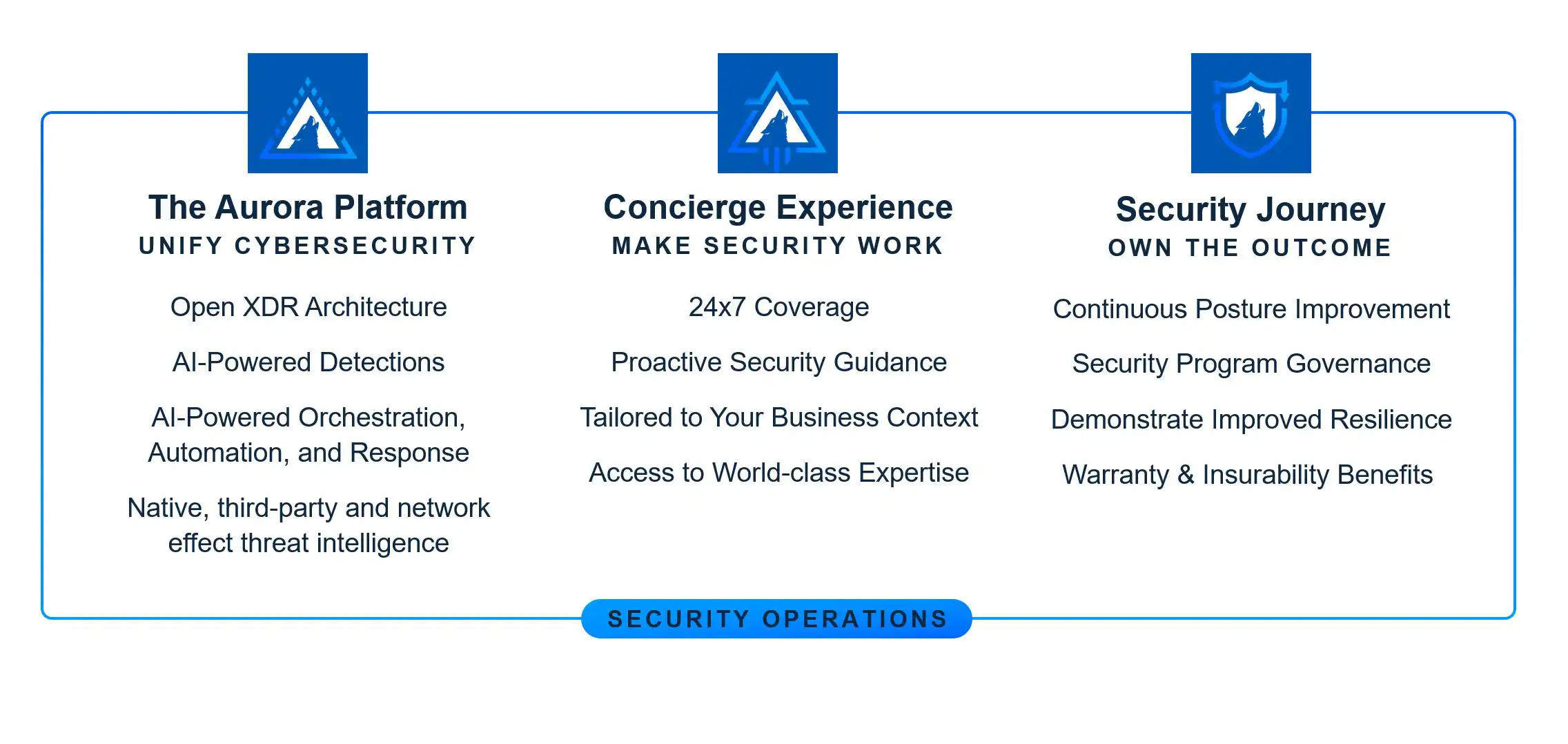
Arctic Wolf’s MDR delivers round-the-clock monitoring, detection, and response across endpoints, networks, and cloud workloads. Leveraging advanced analytics and machine learning, the service surfaces and prioritizes threats in real time while a dedicated Concierge Security® Team works with your organization to guide containment, remediation, and long-term posture improvement. The result is a true security partnership that boosts visibility, accelerates response, and strengthens resilience against today’s rapidly evolving attacks.
Why Hararei for Managed Detection and Response
Deploying MDR is not simply a matter of purchasing a managed security service. The quality of the outcome depends on how well the service is integrated with the customer’s existing security architecture, which telemetry sources are connected, how response responsibilities are defined and how effectively the MDR provider works with the internal IT and security teams.
Hararei helps customers design and implement MDR as part of a broader security operating model. This includes identifying the systems and data sources that should be integrated, reviewing gaps in endpoint, identity, network and cloud visibility, and ensuring that escalation and response processes are aligned with the customer’s operational and risk requirements.
Hararei also provides an independent architecture and integration layer around Arctic Wolf, helping customers connect MDR with the wider security environment rather than treating it as an isolated service. Where required, this can include coordination with endpoint security, identity platforms, firewalls, cloud environments and other controls that support investigation and response.
The objective is to give customers a practical MDR capability that fits their environment, provides meaningful 24x7 threat coverage and can evolve as their security requirements mature.
Independent Recognition of Arctic Wolf
Arctic Wolf has been recognized by independent industry analysts for its managed detection and response capabilities and its broader approach to security operations. Analyst research can provide useful third-party validation when organizations are comparing MDR providers, particularly around service delivery, operational maturity, threat detection and response capabilities.
For customers evaluating Arctic Wolf, this independent perspective can complement technical and commercial assessment by providing a broader view of the provider’s market position, service model and ability to support organizations with ongoing security monitoring and response.
Hararei makes relevant analyst research available to customers who want additional information as part of their MDR evaluation.
Strengthen Your Detection and Response Capability
Managed Detection and Response can provide continuous threat monitoring, expert investigation and structured response without requiring an organization to build and operate a complete 24x7 SOC internally. The right MDR design should fit the existing security architecture, integrate with the most important telemetry sources and establish clear responsibilities for investigation, containment and remediation.
Hararei can help assess your current detection and response capabilities, identify coverage gaps and determine how Arctic Wolf MDR can be integrated into your environment.
Contact Us Please contact Hararei for an in-depth discussion on using any of our Cloud or Cybersecurity products or services