

Action1 provides a cloud-native platform for managing, securing and remediating distributed endpoints without relying on traditional on-premise infrastructure or VPN connectivity. It combines patch management, vulnerability remediation, software management, remote access and endpoint visibility in a single platform designed for modern, distributed IT environments.
Rather than treating vulnerability detection and patch deployment as separate processes, Action1 helps organizations identify exposed endpoints and move directly toward remediation. This shortens the time between discovering a vulnerability and correcting it, reducing the window in which known weaknesses can be exploited.
For organizations managing remote users, branch offices, hybrid workforces or geographically distributed infrastructure, Action1 provides centralized control over endpoints wherever they are located — helping IT teams improve security, simplify operations and maintain a more consistent endpoint posture.
Patch management is one of the most persistent operational gaps in IT — especially across distributed and remote environments. Action1 provides real-time visibility and automated patching across all endpoints, without relying on VPN connectivity or complex infrastructure.
At Hararei, we help organisations implement Action1 as part of a broader endpoint and security strategy — ensuring vulnerabilities are identified and remediated continuously, not periodically.
Most organisations have some form of patch management in place — but gaps remain:
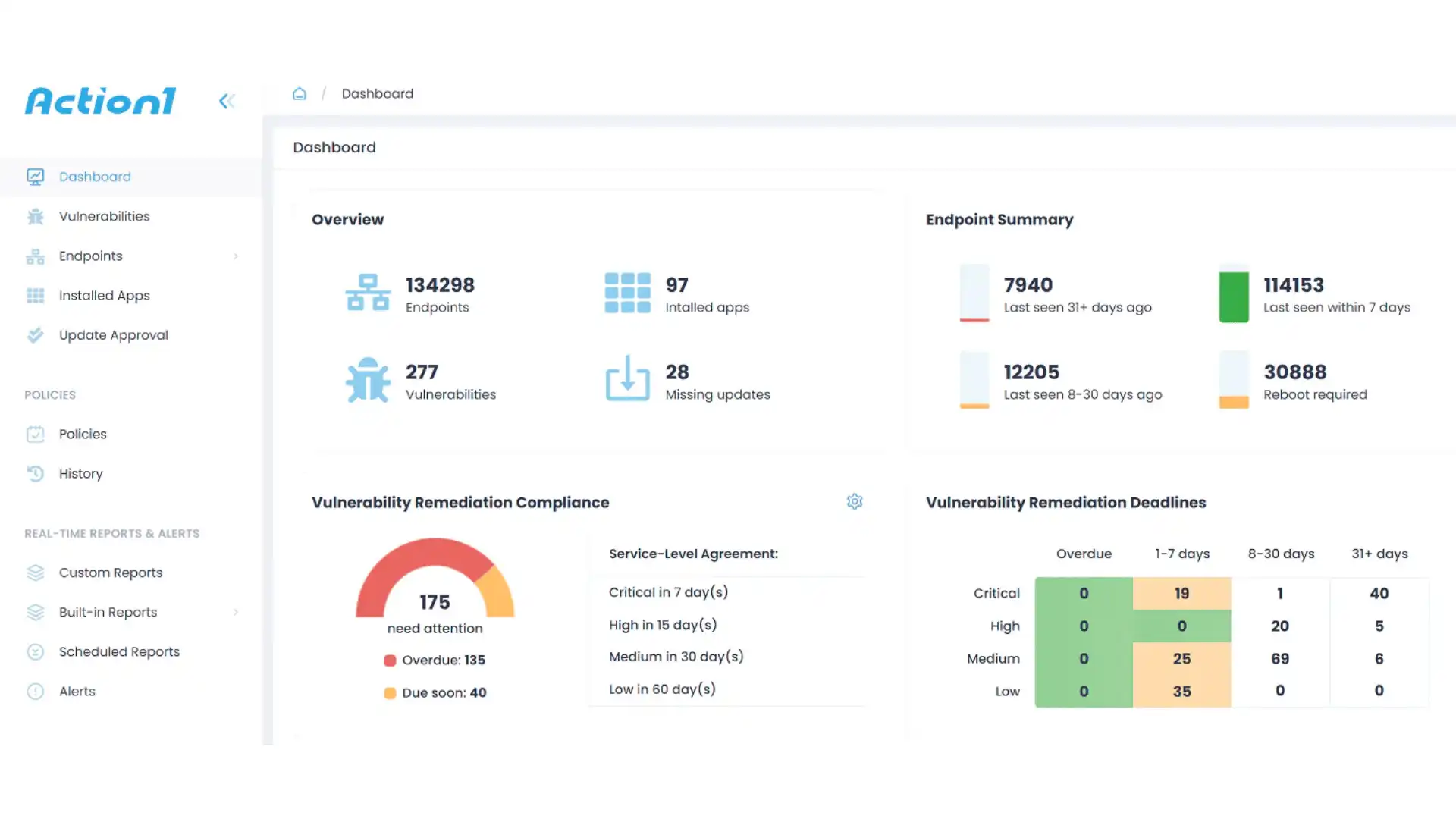
These gaps create exposure — not because tools are missing, but because they are not aligned to how modern endpoints operate. As environments become more distributed, these gaps grow larger — particularly for third-party applications and remote systems that fall outside traditional management models.
Action1 approaches endpoint management differently from traditional on-premises tools that depend on corporate networks, scheduled scans, disconnected management consoles, or users regularly reconnecting through a VPN. Its cloud-native architecture is designed to provide continuous visibility and control across distributed endpoints wherever they are connected.
This changes the operational model from periodic endpoint management to continuous endpoint management. Devices can report status in real time, receive remediation actions over the Internet, and remain manageable even when they are outside the office or rarely connected to the corporate network.
Manage distributed endpoints without requiring additional on-premises management infrastructure.
See endpoint, software, vulnerability and patch status without waiting for periodic inventory or reporting cycles.
Patch and manage endpoints wherever they are connected, without depending on access to the corporate network.
Combine OS patching, third-party application updates, vulnerability remediation and endpoint management in one platform.
The result is a simpler and more responsive endpoint management model. Organizations gain faster visibility into exposure, reduce dependency on network location, and can move from identifying problems to remediating them with less operational delay.
Many endpoint compromises begin with vulnerabilities that are already known and for which fixes are available. The challenge is often not identifying that a vulnerability exists, but ensuring that the affected endpoint is found, prioritized, patched, and verified quickly enough to reduce the window of exposure.
Action1 combines vulnerability visibility with remediation so that security and IT teams can move directly from identifying missing updates to deploying the required patches. This helps reduce the delay between vulnerability discovery and corrective action, particularly across large or distributed endpoint environments.
Continuous assessment is important because endpoint exposure changes constantly. New vulnerabilities are disclosed, applications are installed or updated, devices move between locations, and endpoints may spend long periods away from the corporate network. A periodic patching cycle can leave important gaps between assessment and remediation.
Effective vulnerability remediation is not simply a matter of applying every available update immediately. Organizations need visibility into which endpoints are affected, which vulnerabilities are most important, and whether remediation has actually succeeded.
Action1 provides the operational controls required to identify missing patches, deploy updates, monitor deployment status, and verify remediation from a centralized platform. By combining vulnerability assessment and patch execution, organizations can reduce the number of separate tools and manual handoffs involved in closing endpoint security gaps.
This creates a more direct relationship between vulnerability management and endpoint security: identify the exposure, apply the remediation, and confirm that the vulnerable condition has been removed.
Action1 combines vulnerability remediation, patch management, endpoint visibility and remote administration in a cloud-native platform designed for distributed endpoint environments.
Automate operating system and third-party application patching, identify vulnerabilities in real time, and enforce remediation across managed endpoints.
Maintain current visibility into endpoint hardware, installed software, application versions and other inventory information across the environment.
Deploy software, execute scripts and provide remote support across distributed systems without requiring users to connect through a VPN.
Generate reporting for patch compliance, vulnerability status, software inventory and overall endpoint security posture.
Deploy as a SaaS platform using a lightweight endpoint agent, without requiring additional on-premises management infrastructure.
Action1 has built a strong reputation for usability, particularly among organizations that need to improve patching velocity without adding operational complexity.
On the business software ratings site G2, the platform consistently maintains an exceptional 4.9/5 rating across hundreds of verified reviews, with users highlighting its intuitive interface, rapid deployment, and low administrative overhead. Independent G2 reports have also recognized Action1 as one of the easiest patch management platforms to implement and use. This ease of use matters operationally: when patching workflows are simple, visible, and automated, IT teams can move faster, reduce backlog, and respond to emerging vulnerabilities with far less friction.
Action1 is a cloud-native endpoint management platform designed to simplify patching and remediation across distributed environments.
Understand exactly which endpoints are missing patches at any moment, rather than relying on delayed status updates or periodic reporting.
Manage operating system updates and third-party application patching from a single console, reducing complexity and improving coverage.
Patch and manage endpoints wherever they are, without depending on users connecting back through a VPN or corporate network.
Identify missing patches and remediate vulnerabilities continuously, helping IT teams reduce exposure without excessive manual effort.
Troubleshoot and remediate endpoints directly through the platform, reducing the need for separate remote support tools.
Microsoft Intune focuses on device enrollment, configuration, and policy enforcement. Action1 complements Intune by providing capabilities not natively available, including automated third-party patching, real-time vulnerability assessment, and continuous compliance visibility.
Together, they provide a more complete endpoint management model—combining policy enforcement with operational execution and real-time visibility across distributed environments.
Hararei works with organizations to deploy and operationalize Action1 as part of a broader endpoint management and security strategy. This includes aligning Action1 with existing tools such as Microsoft Intune and ensuring it is implemented in a way that supports long-term scalability and operational simplicity.

Automate the entire patching process for remote and onsite endpoints, from identifying and deploying missing updates to compliance reporting.
Automatically evaluate patch success metrics before advancing through sequential update rings, reducing downtime risks while enabling autonomous remediation.
Prevent security breaches and ransomware attacks. Detect vulnerabilities in OS and applications in real-time, and enforce remediation.
Install, uninstall, and update software on any managed endpoint remotely. Execute scripts in parallel across many endpoints to manage vulnerabilities, remove unwanted files or perform other management actions on remote endpoints.
Securely connect to and troubleshoot endpoints via the cloud console. Assist distributed users remotely. When connected you have access to the remote mouse/keyboard, multiple monitors (if present), shared clipboard, etc.
Generate reports for patch compliance, software inventory, and security posture (e.g., CIS, NIST, ISO). Track software licenses, hardware configurations, hardware and software inventories and application versions.
The datasheet describes the main features of the product in more detail
10 Signs Your Infrastructure Is At Risk
Want to Understand How Action1 Complements Microsoft Intune?
Patch Compliance Quick Reference Sheet (Cheatsheet)
Hararei can help you assess your current patch management processes, identify operational gaps, and determine whether Action1 is the right fit for your environment.
Contact Us Please contact Hararei for an in-depth discussion on using any of our Cloud or Cybersecurity products or services